|
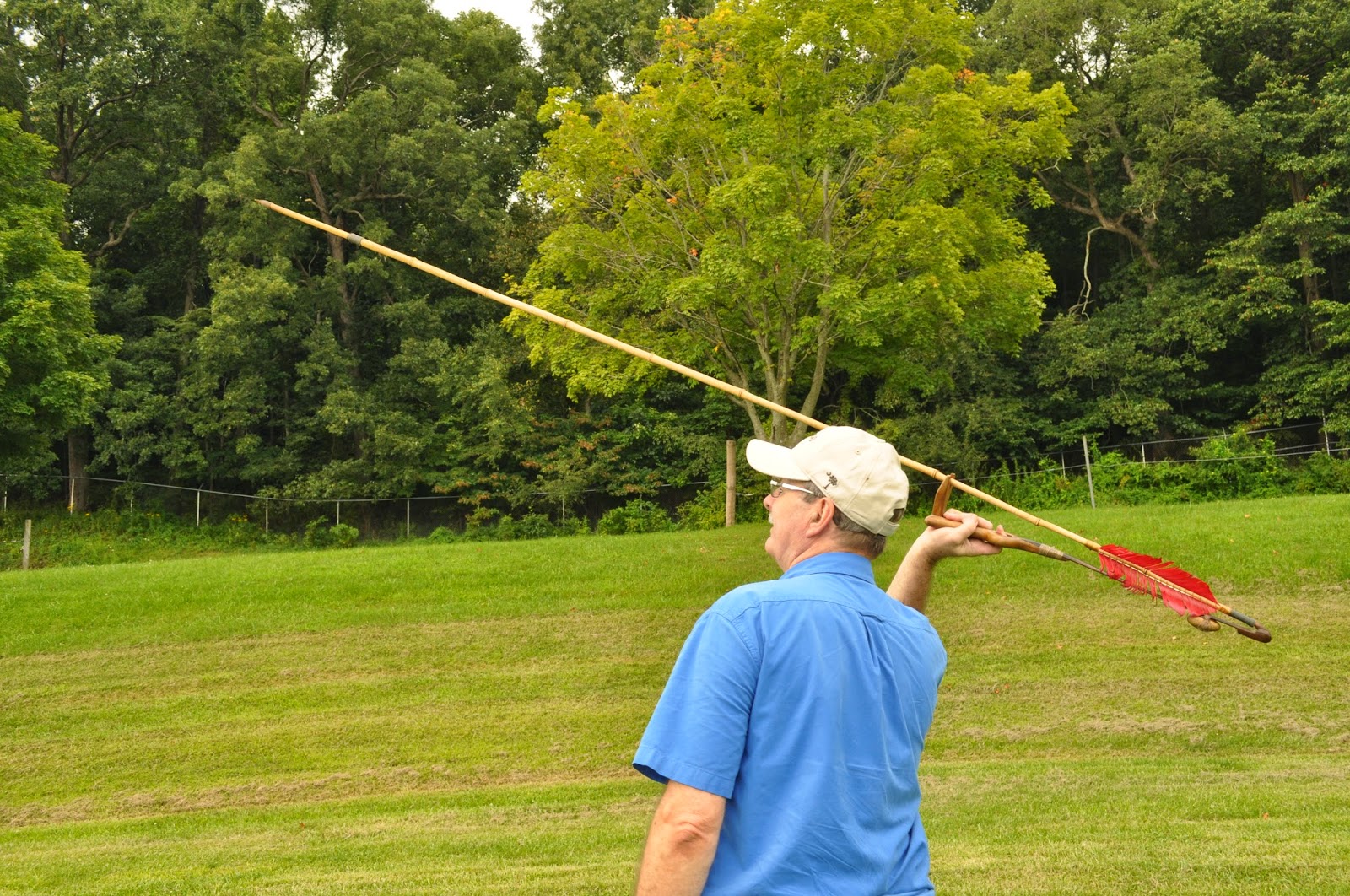
| Bob Berg of Thunderbird Atlatl in Candor, New York, gives a 3-hour atlatl-and-spear-making workshop at Kenyon College, on his way to the annual Flint Ridge Knap-In at Flint Ridge Memorial State Park this Memorial Day weekend. (Photo by Don Comis) |
I really enjoyed the atlatl-and-spear-making demonstration put on by Bob and Cheryll Berg tonight. It was held outside the Brown Family Environmental Center at Kenyon College, around a campfire pit. There was a big crowd that took up all the seating on benches and a couple of Adirondack chairs, with others sitting on the ground or standing.
The Bergs are a folksy couple, easy to talk to and learn from. Bob is particularly funny, joking all the time as he made first the spear, also called a dart, and then the atlatl (which he pronounces “at-lattle”).
He likes to use local materials so he searched the nearby brush and found a goldenrod stem to make the shaft of the spear and a small branch to make the atlatl. He was glad a young man in the audience had brought a block of flint he found while kayaking the Walhonding River.
To turn the flint into an arrow, Bob pounded it with a copper-tipped tool, hitting it at precise angles to flake off layers of flint to create sharp edges, a process called flint-knapping. Prehistoric people used bone or wood to do this. Then he placed the forming arrowhead against a piece of rubber and pounded it again in a process called pressure knapping. In the old days, this would be done against a piece of leather.
Then he heated pine pitch in a bowl and used it to glue the arrowhead to the spear shaft, after sticking it into a split he made in the end of the shaft. After that, he wrapped flax fibers around the shaft and arrowhead and brushed on more pine pitch, to form the pitch and fiber into a composite that holds the arrowhead to the shaft.
He finished off the spear with turkey feathers he brought with him.
Now it was time for the atlatl making. He made that in minutes, just shaving the bark off the wood and creating a hook or spur at the end for insertion into a depression Bob made at the firing end of the spear.
I was a bit shocked at how basic it was, foolishly thinking I’d see the fancy atlatls made in woodshops. But those who tested it said it worked well.
The Bergs let us use his various commercial atlatls and spears for hours. David Heithaus, facilities manager for the Brown Center, startled us with a 70 to 75 meter throw. Mostly we shot at a closer target and one participant got a bull’s eye on his second throw, more astounding considering that his first throw was like all of mine, a quick downward arc to the ground.
I couldn't get the wrist-flicking follow through that is key to launching the spear with more force and speed than without the atlatl. Bob said It give you another arm’s length reach, since the atlatl is about the length of an arm. Bob has timed the spear’s speed with a car, seeing speeds of 60 to 80 miles per hour.
Bob encouraged me on the prospects of finding “points”—stones sharpened by man for use as spear heads, arrowheads, knives and other toolss--when he pointed to a nearby crop field , saying that he could guarantee us there are thousands of them per acre in that field, because the field is near the Kokosing River. They usually get there by being thrown at something. If one is found at the surface, there are probably more down to three feet below.
After the workshop, Chris Balazs, a lifelong collector and finder of prehistoric artifacts, confirmed the prospects for me by calculating me that a hypothetical family of five could make 5 tools a day over 20 years of projected adult life, which would result in 36,500 points and other tools in just 20 years for one family.
Heithaus struck it lucky when contacting the Bergs with archaeological questions and found they would be in the area this weekend for an annual Knap-In, demonstrating the art of making arrowheads, spears, bows, and many other items at Flint Ridge State Memorial Park, so they could give a demonstration at the Brown Center.
The Bergs live in Candor, New York, where they operate Thunderbird Atlatl, billed as the largest manufacturer of atlatls in the world. Bob said that about 15 or 20 years ago, he started making and hunting with atlatls, the only people doing that at the time. This gave him many insights into what found artifacts were or were not used in making atlatls, particularly the stone weights used on the stem or handle of the atlatl. Balazs had come to ask Bob whether he thought certain “bannerstones” were used as atlatl weights as commonly believed. Bob said he didn’t and that the ones Balazs described were actually made as a tool for women to spin thread!
Bob told Balazs that he starts by making and experimenting with devices like atlatls while Balazs starts at the other end by theorizing about uses of found artifacts and that they should meet in the middle.
In my six months with the Kokosing Chapter of the Archaeological Society of Ohio, I’ve learned that the blend of experimenting and theorizing is the only way to make the best guess at uses of artifacts, since there the use of an object is always anybody’s best guess. But applying the common sense gained from making and using an object, makes that a more educated guess.
It reminds me of Scot Stoneking, the speaker at our chapter’s February 20 meeting who upended the popular view of artifacts called cupstones, small sandstones with depressions. Long thought to be for grinding nuts, Stoneking decided they were actually used to “sand” the bottom of a piece of deer antler used to fracture flint into pieces that can be shaped into arrowheads and other points . His most convincing proof was his ability to replicate the depressions in one minute on demand, while no one had ever duplicated the depressions with nuts.
I have his slideshow presentation on my website, under “Archaeological Slides”.