Showing posts with label Archaeological Society of Ohio. Show all posts

Wednesday, September 17, 2014

Mastodon Tusks and Ankle Bones May Have Been Located


The 8-inch wide re-assembled mastodon tooth that launched the dig was on display at the site on September 14.  (Photo by Don Comis)

On Saturday, September 14, an archaeologist switches from metal trowel to wooden instrument for the delicate work required for uncovering more of the large bones found on Sunday, September 13, in Unit 14.  I think he skipped lunch because he was so caught up in the task.  (Photo by Don Comis)

Well they said the big bones would start showing up and they did for our Sunday, September 14 mastodon dig in Morrow County.  Learning my route for my third weekend of digging and sifting, I got there early and saw what a special dig the day before had uncovered—what looks like mastodon leg bone from the ankle down as well as assorted other good chunks of bone half buried still in Units  14 and 15.

In his latest report to volunteers, Dr. Nigel Brush, with Ashland University, said that, “The tusk fragments are getting larger and Cathy Hancock noted that most of the material from Unit 4 this week were tusk fragments, so undisturbed portions of the tusk may lie in that direction (the two teeth were found in Unit 5)."

It was the discovery of a tooth by a soybean farmer about a year-and-a-half ago that launched this dig that began on August 23.  The tooth had been unearthed during the digging of a ditch to lay drainage pipe.

I’ve only got three days of digging experience but the finding of teeth in nearby Unit 5 and the possibility of the tusks being in Unit 4  makes me wonder if the mastodon’s head isn’t under Units 4 and 5—and I can begin to visualize the body connecting the head to the legs reaching Units 14 and 15.  I’m hoping anyway.

I was sifting soil for Unit 4 on Sunday and I noticed we were seeing more and more little fragment s of tusk and other bones and I started finding bone fragments on my own for the first time, including one that was not so small.  However, three youngsters outdid me even though this was their first day:  While helping us sift soil dug from Unit 4, Garrett Harvey, 9, found 5 small pieces of tusk, Kendra Harvey, 12, found 7 tusk pieces, and Miranda Harvey, 15, found 4 tusk pieces and 3 pieces of flint.  Flint pieces are saved in case they turn out to be parts of weapons that could indicated the mastodon was killed by prehistoric Native American hunters.

 Kim Harvey, a 6th grade science teacher, brought her children to the dig because she shares my belief that youngsters should do more outdoor science.

We were sifting dirt dug from the 8- to 12-inch deep layer on Sunday.   I was also digging in Unit 4 on my very first day of digging, removing soil down to 8 inches and we found nothing.  The first foot of soil is the plow layer, where it’s less likely to find much because of the disturbance of plowing.  On September 6, I was working in Unit 16 and my partner, Jeff, was finding bones, including a good-sized one that was near Unit 15.
While an archaeologist in Unit 14 carefully uncovers large bones that may include ankle bones, markers have been laced in Unit 15 where large bones were also found.  (Photo by Don Comis)

Some of the units have been dug down to 16 inches.

There was very careful trowel and wood pick work going on in Units 14 and 15, to slowly uncover the larger bones.

One of the volunteers told me that the fact the mastodon seemed buried in a shallow grave meant that he may have died “only” 11,000 years ago, rather a million or more years ago, promising a better preserved skeleton might be found.

I sifted dirt from Unit 4 with Steve House,  president of the Muskingum [County] Chapter of the Archaeological Society of Ohio.   It took me a while to realize he had done the atlatl demonstration at the annual potluck and auction of the Kokosing Chapter which I belong to.

The re-assembled mastodon tooth that started this dig was on display.  Seeing it and asking questions I learned that I should say the tooth is about 8 inches wide, rather than 8 inches long.  The teeth are not long because a mastodon is a vegetarian that just chomps on small trees and other plants.   Each tooth can have about 10 cusps or ridges, compared to about four each for our teeth, which tend to be longer than they are wide.

It turns out that the tooth gives the mastodon its name because the cusps look like nipples.  And the tooth is one of the best ways to distinguish a mastodon from a wooly mammoth.  The mastodon is a forest animal that eats small trees, twigs and leaves, so its teeth are designed for crunching.  A wooly mammoth is a grasslands animal with teeth suited for cutting grass.


The next dig occurs Saturday, September 20—the day after my birthday.  Maybe I’ll get a mastodon for a present!

For more photos, go to "Mastodon Dig" on my website.

Thursday, August 21, 2014

Real Men Use Atlatls, Not Bow-and-Arrows : Part I

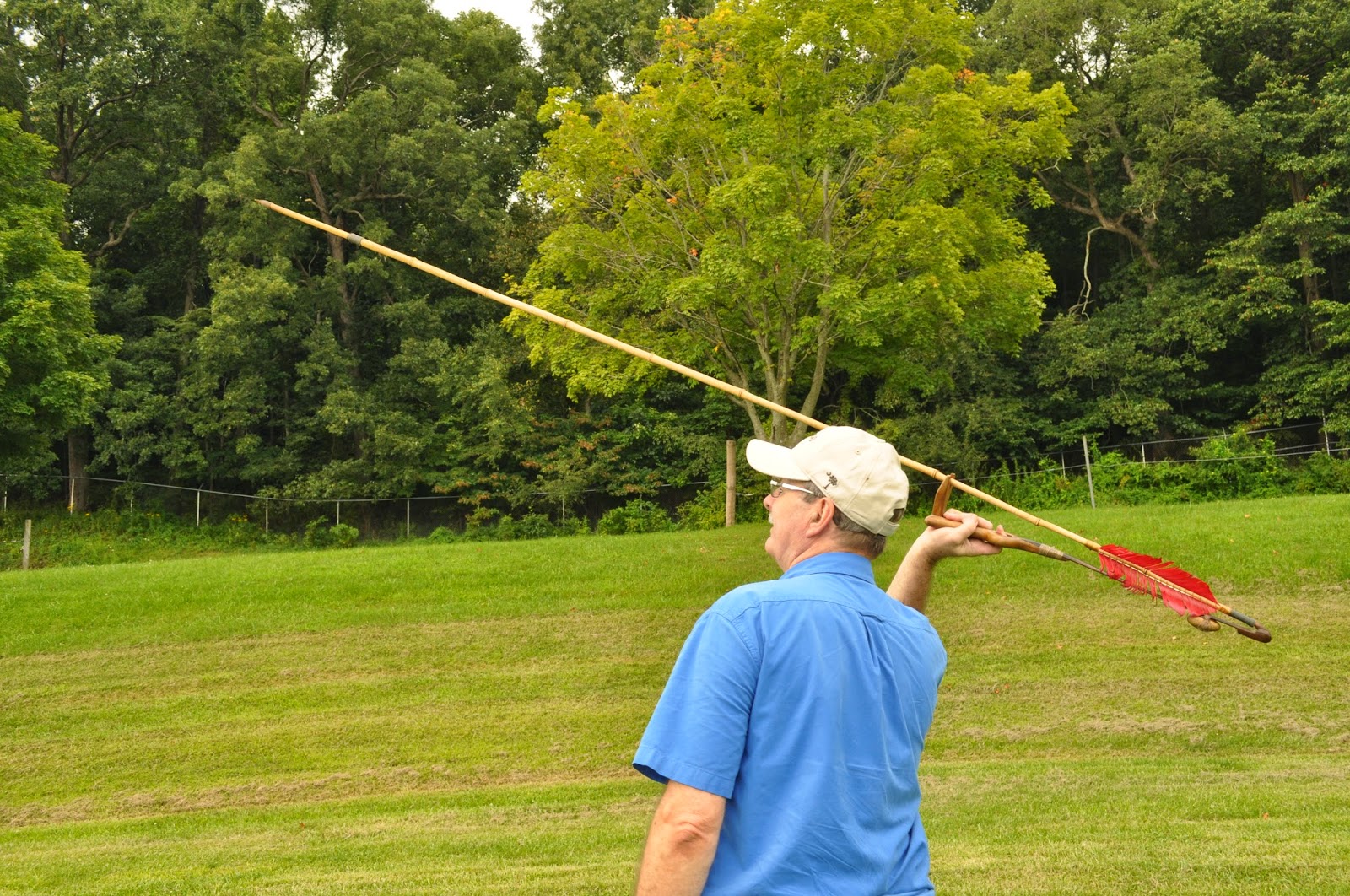
At the annual picnic of the Kokosing Chapter of the Archaeological Society of Ohio (ASO)--held at the Knox County Fairgrounds--Steve House gets ready to launch a spear with an atlatl, a device used for tens of thousands of years worldwide for more killing power with much less effort.  House has a degree in archaeology and is president of the Muskingum Chapter of  ASO.  (Photo by Don Comis)

House sends the spear on its way (visible in sky in far top left of photo).  It impaled itself in the ground, by a tree,  abut 50 yards from House.  (Photo by Don Comis)


What can go 100 miles an hour and reach 600 yards, pre-dating the bow-and-arrow?  The answer, an “atlatl”, doesn’t tell you much, let alone how to pronounce it.

But prehistoric man, dating back to about 30,000 years ago, used this home-made, hand-held device to launch their spears with more power and distance and less wear and tear on the hunters’ bodies.

I first heard about these devices when I joined the Kokosing Chapter of the Archaeological Society (ASO) of Ohio, but I couldn’t grasp what they really looked like or how they worked based on just verbal descriptions and sketches.

So I was thrilled to learn that there would be a demonstration of atlatl spear-throwing at the annual picnic of our archaeological club tonight—and that the Brown Family Environmental Center at Kenyon College would have a demonstration of making atlatls on Thursday, August 28, from 4 to 7 p.m.  Two representatives of Thunderbird Atlatl, the world’s largest atlatl manufacturer, will conduct the demonstration.

Steve House, president of the Muskingum Chapter of the  ASO,  demonstrated the atlatl  outside of our picnic area, shooting spears into a target.  He took me farther away to demonstrate a long distance throw and I watched him launch he spear about 50 yards, impaling itself in the ground near a tree.

House said that a man in southwest Ohio recently won first place in the World Atlatl Association’s International Standard Accuracy Contest with almost a perfect score.  The atlatl is still in use throughout the world.  It can kill big game such as elk, bear, and deer.   Pennsylvania has a limited season for hunting with an atlatl.  Missouri allows hunting with an atlatl only for small game, not deer, while in the south the device is combined with a reel and used to fish.

House showed several types of atlatls and talked about the complex design that launches spears with such force, including a balancing weight.  His spears had small copper tips.  The tips can be small and lightweight because much of the killing power is in the force with which the spear is launched.

He used bamboo for his spears but said primitive man used many different woods and other materials such as marsh grasses.  House’s spears were not much taller than him, but he said that some hunters use long spears, citing South American hunters  with 12-foot-long  spears .

I should get used to taking videos so I could have shown House practicing with his spears until late in the evening.  Besides, I couldn’t take all the still photos I wanted because I didn’t have a full battery, although I own three camera batteries.

I’ll write Part II on August 28, after seeing how atlatls are made, at Kenyon College.  The Ohio Atlatl Association has a Facebook page.  Also, Ray Strischek , who makes and throws atlatls in Athens, Ohio, has a nice website.

The Kokosing Chapter has meetings open to the public on the third Thursday of each month, at 7:30 p.m. at the Knox County Career Center.  For more details, check out the "Archaeological Finds" and "Archaeological Slides" sections of my website.


Friday, April 25, 2014

A Glimpse of Native Americans in 2,500 B.C.

Imagine a Native American burial in 2,500 B.C. in Ohio.  The body is dressed in a fine deerskin outfit, completely covered with sewn-in small marine shells obtained from traders from the Gulf Coast.  The shell beads are also on the warrior's necklace, spaced artistically between the hollow leg bones of a Great Blue Heron and the teeth of bear and elk, along with a few human teeth.  Part of a wolf jaw bone is the centerpiece of the necklace.

Another honor for the warrior:  A stone weight of the type attached to a spear throwing device made from an elk antler.

It wasn't hard for amateur archaeologist Greg Shipley to imagine this scene since he saw much of it in  a cemetery below a farm field in Champaign County, Ohio.

He found nine of the stone weights (bannerstones) , a few thousand shell beads, and the necklaces.  He only had to guess the deerskin part because the clothing the beads were once attached to had long disintegrated.

Shipley is one of many citizen science archaeologists making contributions in the field.  Now armed with ground penetrating radar he is calling attention to what lies under our feet.

Oh, and he dated the cemetery finds to 2,500 B.C. give or take 80 years when a scientist carbon-dated charred material Shipley found in the cemetery.

I saw Shipley's presentation, both slides and actual artifacts, at April's meeting of the Kokosing Chapter of the Archaeological Society of Ohio at Mt. Vernon, Ohio.
While glimpses of Native Americans in 2500 BC excite Greg Shipley, he has a special passion for the waning days of the American and Ohio frontier, in the days of General Anthony Wayne, shown here dictating the treaty terms that ended Native American control of much of Ohio.  (Painting on display in Ohio Statehouse.)