Thursday, August 28, 2014

Atlatls a Sport for all Ages--Part 2


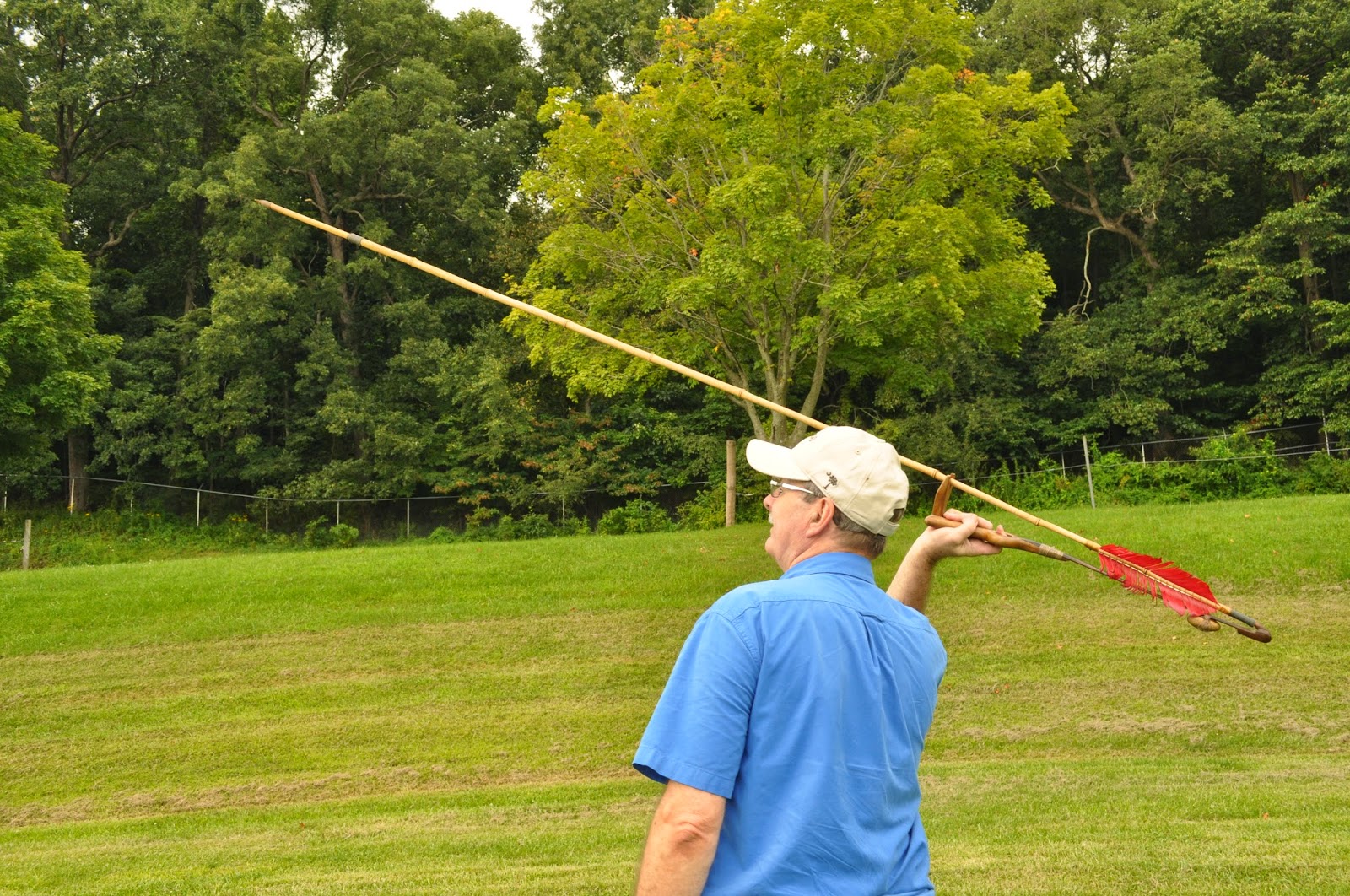
Bob Berg of Thunderbird Atlatl in Candor, New York, gives a 3-hour atlatl-and-spear-making workshop at Kenyon College, on his way to the annual Flint Ridge Knap-In at Flint Ridge Memorial State Park this Memorial Day weekend.  (Photo by Don Comis)


I really enjoyed the atlatl-and-spear-making demonstration put on by Bob and Cheryll Berg tonight.   It was held outside the Brown Family Environmental Center at Kenyon College, around a campfire pit.  There was a big crowd that took up all the seating on benches and a couple of Adirondack chairs, with others sitting on the ground or standing.

The Bergs are a folksy couple, easy to talk to and learn from. Bob is particularly funny, joking all the time as he made first the spear, also called a dart, and then the atlatl (which he pronounces “at-lattle”).

He likes to use local materials so he searched the nearby brush and found a goldenrod stem to make the shaft of the spear and a small branch to make the atlatl.   He was glad a young man in the audience had brought a block of flint he found while kayaking the Walhonding River.

To turn the flint into an arrow, Bob pounded it with a copper-tipped tool, hitting it at precise angles to flake off layers of flint to create sharp edges, a process called flint-knapping.   Prehistoric people used bone or wood to do this.  Then he placed the forming arrowhead against a piece of rubber and pounded it again in a process called pressure knapping.   In the old days, this would be done against a piece of leather.

Then he heated pine pitch in a bowl and used it to glue the arrowhead to the spear shaft, after sticking it into a split he made  in the end of the shaft.  After that, he wrapped flax fibers around the shaft and arrowhead and brushed on more pine pitch, to form the pitch and fiber into a composite that holds the arrowhead to the shaft.

He finished off the spear with turkey feathers he brought with him.

Now it was time for the atlatl making.  He made that in minutes, just shaving the bark off the wood and creating a hook or spur at the end for insertion into a depression  Bob made at the firing end of the spear.

I was a bit shocked at how basic it was, foolishly thinking I’d see the fancy atlatls made in woodshops.  But those who tested it said it worked well.

The Bergs let us use his various commercial atlatls and spears for hours.   David Heithaus, facilities manager for the Brown Center, startled us with a 70 to 75 meter throw.  Mostly we shot at a closer target and one participant got a bull’s eye on his second throw, more astounding considering that his first throw was like all of mine, a quick downward arc to the ground.

I couldn't get the wrist-flicking follow through that is key to launching the spear with more force and speed than without the atlatl.   Bob said It give you another arm’s length reach, since the atlatl is about the length of an arm.   Bob has timed the spear’s speed with a car, seeing speeds of 60 to 80 miles per hour.

Bob encouraged me on the prospects of finding “points”—stones sharpened by man for use as spear heads, arrowheads, knives and other toolss--when he pointed to a nearby crop field , saying that he could guarantee us there are thousands of them per acre in that field, because the field is near the Kokosing River.  They usually get there by being thrown at something.  If one is found at the surface, there are probably more down to three feet below.

After the workshop, Chris Balazs, a lifelong collector and finder of prehistoric artifacts, confirmed the prospects for me by calculating me that a hypothetical family of five could make 5 tools a day over 20 years of projected adult life, which would result in 36,500 points and other tools in just 20 years for one family.

Heithaus struck it lucky when contacting the Bergs with archaeological questions and found they would be in the area this weekend for an annual Knap-In, demonstrating the art of making arrowheads, spears, bows, and many other items at Flint Ridge State Memorial Park, so they could give a demonstration at the Brown Center.

The Bergs live in Candor, New York, where they operate Thunderbird Atlatl, billed as the largest manufacturer of atlatls in the world. Bob said that about 15 or 20 years ago, he started making and hunting with atlatls, the only people doing that at the time.  This gave him many insights into what found artifacts were or were not used in making atlatls, particularly the stone weights used on the stem or handle of the atlatl.   Balazs had come to ask Bob whether he thought certain “bannerstones” were used as atlatl weights as commonly believed.  Bob said he didn’t and that the ones Balazs described were actually made as a tool for women to spin thread!

Bob told Balazs that he starts by making and experimenting with devices like atlatls while Balazs starts at the other end by theorizing about uses of found artifacts and that they should meet in the middle.

In my six months with the Kokosing Chapter of the Archaeological Society of Ohio, I’ve learned that the blend of experimenting and theorizing is the only way to make the best guess at uses of artifacts, since there the use of an object is always anybody’s best guess.   But applying the common sense gained from making and using an object, makes that a more educated guess.

It reminds me of Scot Stoneking, the speaker at our chapter’s February 20 meeting  who upended the popular view of artifacts called cupstones, small sandstones with depressions.  Long thought to be for grinding nuts, Stoneking decided they were actually used to “sand” the bottom of a piece of deer antler used to fracture flint into pieces that can be shaped into arrowheads and other points .  His most convincing proof was his ability to replicate the depressions in one minute on demand, while no one had ever duplicated the depressions with nuts.

I have his slideshow presentation on my website, under “Archaeological  Slides”.

Wednesday, August 27, 2014

Complete Mastodon Skeleton? An Update

Paleo Indians, Ohio's first human inhabitants, attacking a mastodon.  (Illustration from Martha A. Potter's 1968 book "Ohio's Prehistoric Peoples".)


On Saturday, August 23, the first day of the dig at the Cedar Creek Mastodon Site, near the Morrow-Richland County line in Ohio,  archaeologists and volunteers uncovered enough mastodon parts to increase hope that a complete skeleton may be found.

In his August 25 update e-mail to volunteers, Dr. Nigel Brush, associate professor of geology at Ashland University, said that the crew and volunteers found bone fragments that “appear to be from the ribs, and vertebrae or leg bones.”   They recovered pieces of bone, tusk, and tooth enamel from six of seven units dug, each two- by two-meters.  The only unit where nothing was found is the one closest to a nearby bog.

Brush said that on August 22, he and Dr. Nick Kardulias, chair of the archaeology program at the College of Wooster, and colleagues found a mastodon tooth while preparing the site for Saturday’s excavation.

The plans for this excavation began last year when a farmer spotted what looked like an unusual rock while walking along a newly installed drainage ditch on one of his soybean fields.   After a light cleaning, the rock turned out to be the crown of a mastodon tooth.

 In a December 3, 2013 posting on the Ohio History Connection Archaeology Blog, Bill Pickard said that, “A little further investigation turned up more tooth fragments as well as fragments of the mandible or lower jaw bone. While not every day occurrences, isolated mammoth and mastodon teeth do turn up from time to time. They are the most durable part of the animal’s anatomy and can remain intact long after the other skeletal parts have decayed and disappeared. It is also the case that teeth are shed as they become worn and are replaced by new growth from the rear of the jaw. The fact that there was more than one tooth represented in all the enamel pieces and that jaw bone fragments also turned up indicates that the tooth enamel was likely not the residue of an isolated tooth and that there may be more skeletal parts remaining. Is there a complete skeleton there waiting to be discovered? It’s hard to say.”

He said that, “The find spot was immediately adjacent to a natural pond and the tile was installed to follow a natural swale that drained higher parts of the field into the pond. The tile trench was inadvertently dug through the level where the teeth and jaw bone material were lying, that is about three feet below the surface.”

Pickard added that, “A possible scenario is that thousands of years ago the remains of a dead mastodon were somewhere not too far upslope from the pond and over time this material moved downward towards the wetland when the swale acted more like a full time stream. Eventually some of the skeletal members or perhaps the whole carcass would become buried in transported sediments near the edge of the present day pond.”

In the August 17 letter, Brush said there is the possibility that this mastodon may have been driven into the nearby bog by Paleo Indians “in order to trap, kill, and butcher it, so we will also be looking for flint tools or evidence of cut-marks on the bones.”

 In that same letter, Brush also said that the backhoe digging this drainage ditch “seems to have hit the skull.”   In his August 25 e-mail, Brush said that, “Our primary purpose in removing the disturbed soil from the ditch [on August 23] was to locate the point at which the backhoe had cut through the skull and tusks.  We are assuming that undamaged portions of the skull and tusks should be present in the undisturbed soil along the walls of the ditch.”

Brush continued, “One tiny projectile point was also recovered during the excavation.  However, since it was a Merom Expanding Stemmed point that dates between 1600 B.C. to 810 B.C., it was deposited at the site thousands of years after the time of the mastodon (+ 8000 B.C.).”

He also said that "a reporter from the Mansfield News Journal also visited our excavation on Saturday and her article was on the front page of Monday’s paper.

Note:  I got on the volunteer waiting list and will know tomorrow (Thursday) whether there will be enough volunteers for another dig on Saturday, August 30.

Sunday, August 24, 2014

Night Birding

First page of Diana Doyle's story in the current issue of  Birding Magazine.

How about birdwatching at night?  I never thought of it until I read Diana Doyle’s latest “Tools of the Trade” article (“NFC [Nocturnal Flight Calls] 101:  Birding for (Geeky) Insomniacs”) in the July/August 2014 issue of the American Birding Association’s Birding magazine.

Doyle describes a way of identifying bird sounds at night by recording them and then using software to turn them into identifying spectrograms.   She says that “All it takes is to adapt items you probably already own, such as a smartphone or digital recorder, and a laptop, with a couple of low-cost or free resources.”

There is an option to supplement the smartphone recorder with an external mic such as Edutige's EIM-003 mic for an iPhone, at $47, or the ESM-010 S-Microphone for Samsung.   Doyle cites the RODE Rec recording app for smartphones.

Two years ago, Birding editor Ted Floyd wrote a blog on his success with a compact Olympus recorder.  He also wrote a new online review and tutorial ("How to Record Birdsong").

After recording, you create a spectrogram from a short snippet of each different flight call using software for your computer.  Doyle cites two free software programs:  Audacity and the Cornell Lab of Ornithology's Raven Lite.

She says that step one is to save the backyard recording to your computer, then, with Audacity or Raven Lite, transfer the file into a spectrogram.  For details using Audacity, see Floyd’s online tutorial.

Then you compare the spectrogram with those for known species shown on the "Flight Calls of Migratory Birds" CD.  Doyle cites other sound spectrogram sources for comparison, including the iBird smartphone app I mentioned briefly in my July 18, 2014 blog blog on the Merlin Bird ID app.

I’ve also written a previous blog mentioning the only other nocturnal birdwatching I’ve heard about:  Chandler (“Chan”) Robbins, the “Father of Modern Ornithology”,  told me how he and his wife have spent full moon evenings staying up all night using a telescope with a grid pattern to count the silhouettes of migratory birds passing the moon.

I think he said he counted about 250,000 birds in one night passing over his home in Laurel, Maryland.

Robbins had no way of identifying species from silhouettes.  But I’m wondering what would happen if someone set up a recorder while watching the moon?   The recording can’t take place all night because the files are so big.  Doyle instead suggests recording from a half hour to two hours at different times on different nights to catch more species.

I'm finding all of Doyle's regular articles in Birding to be great!

Saturday, August 23, 2014

Mastodon Found in Ohio Soybean Field


 Illustration from "Ohio's Prehistoric Peoples" depicting Paleo-Indians attacking a mastadon.  Makes me wonder why they didn't use atlatls or throwing sticks to kill from afar.  See my earlier  blog on atlatls.


At my local archaeology club annual potluck and auction on August 21, I picked up a flyer looking for volunteers for excavating a buried mastodon near the Richland/Morrow County line in Ohio, starting Saturday, August 23. 

The flyer explained that a backhoe digging a drainage ditch last year uncovered a mastodon tooth, bits of bone, and tusk fragments.  It may also have hit the mastodon’s skull.  The ditch drains water from a soybean field to a pond.    The man who farms that field discovered the tooth and bone fragments after the ditch was dug.

If the rest of the mastodon is found, the archaeologists will be digging every Saturday through at least September.

The group doing the dig last uncovered a mastodon 21 years ago.

In a book I bought at the auction, “Ohio’s Prehistoric Peoples”, the author, Martha Potter, says that mastodons, mammoths, giant elks, giant beavers, musk oxen, horses, and tapirs moved into what is now Ohio after the Wisconsin glacier began retreating, about 12,000 B.C.  “Practically all of these animals, however, had become extinct by about 3,000 B.C.,” she wrote in the book published by The Ohio Historical Society in 1968.

Potter, who was at the auction and signed my copy of the book, also mentions a mastodon skeleton found in Madison County and the remains of a giant beaver found in Franklin County, near Columbus, Ohio.  She says that, “Radiocarbon dates indicated that the giant beaver was here almost 10,000 years ago and the mastodon about 8,000 years ago.  Although none of these Ohio Pleistocene mammals have been found together with human skeletons or with man-made tools, it is highly possible that man was actually living here 11,000 years ago.  Ohio’s first human inhabitants, the Palaeo-Indians [also spelled "Paleo-Indians"], followed the movements of the animals and the retreating ice.”

The flyer says that one possibility is that the Paleo-Indians may have driven the mastodon into a nearby bog “to trap, kill, and butcher it, so we will also be looking for flint tools or evidence of cut-marks on the bones.”
More information on this find can be found on this website page of the Ohio History Connection Archaeology Blog. 

I hope to get on the waiting list for volunteers on this dig, so stay tuned!


Thursday, August 21, 2014

Real Men Use Atlatls, Not Bow-and-Arrows : Part I

At the annual picnic of the Kokosing Chapter of the Archaeological Society of Ohio (ASO)--held at the Knox County Fairgrounds--Steve House gets ready to launch a spear with an atlatl, a device used for tens of thousands of years worldwide for more killing power with much less effort.  House has a degree in archaeology and is president of the Muskingum Chapter of  ASO.  (Photo by Don Comis)

House sends the spear on its way (visible in sky in far top left of photo).  It impaled itself in the ground, by a tree,  abut 50 yards from House.  (Photo by Don Comis)


What can go 100 miles an hour and reach 600 yards, pre-dating the bow-and-arrow?  The answer, an “atlatl”, doesn’t tell you much, let alone how to pronounce it.

But prehistoric man, dating back to about 30,000 years ago, used this home-made, hand-held device to launch their spears with more power and distance and less wear and tear on the hunters’ bodies.

I first heard about these devices when I joined the Kokosing Chapter of the Archaeological Society (ASO) of Ohio, but I couldn’t grasp what they really looked like or how they worked based on just verbal descriptions and sketches.

So I was thrilled to learn that there would be a demonstration of atlatl spear-throwing at the annual picnic of our archaeological club tonight—and that the Brown Family Environmental Center at Kenyon College would have a demonstration of making atlatls on Thursday, August 28, from 4 to 7 p.m.  Two representatives of Thunderbird Atlatl, the world’s largest atlatl manufacturer, will conduct the demonstration.

Steve House, president of the Muskingum Chapter of the  ASO,  demonstrated the atlatl  outside of our picnic area, shooting spears into a target.  He took me farther away to demonstrate a long distance throw and I watched him launch he spear about 50 yards, impaling itself in the ground near a tree.

House said that a man in southwest Ohio recently won first place in the World Atlatl Association’s International Standard Accuracy Contest with almost a perfect score.  The atlatl is still in use throughout the world.  It can kill big game such as elk, bear, and deer.   Pennsylvania has a limited season for hunting with an atlatl.  Missouri allows hunting with an atlatl only for small game, not deer, while in the south the device is combined with a reel and used to fish.

House showed several types of atlatls and talked about the complex design that launches spears with such force, including a balancing weight.  His spears had small copper tips.  The tips can be small and lightweight because much of the killing power is in the force with which the spear is launched.

He used bamboo for his spears but said primitive man used many different woods and other materials such as marsh grasses.  House’s spears were not much taller than him, but he said that some hunters use long spears, citing South American hunters  with 12-foot-long  spears .

I should get used to taking videos so I could have shown House practicing with his spears until late in the evening.  Besides, I couldn’t take all the still photos I wanted because I didn’t have a full battery, although I own three camera batteries.

I’ll write Part II on August 28, after seeing how atlatls are made, at Kenyon College.  The Ohio Atlatl Association has a Facebook page.  Also, Ray Strischek , who makes and throws atlatls in Athens, Ohio, has a nice website.

The Kokosing Chapter has meetings open to the public on the third Thursday of each month, at 7:30 p.m. at the Knox County Career Center.  For more details, check out the "Archaeological Finds" and "Archaeological Slides" sections of my website.


Tuesday, August 19, 2014

Don't Give Worms a Bad Rap!

Earthworms are so valuable to soil that the U.S. Department of Agriculture's Natural Resources Conservation Service (formerly Soil Conservation Service) longed to have a worm mascot.  I remember one candidate called "Ernie the Worm".  So it's  no surprise to see this mascot on a table of the Knox County Association of Garden Clubs table on Earth Day 2014.  Bags of worm casting fertilizer were on sale at this table.   So let's be careful about painting their faults with too wide a brush!  (Photo by Don Comis)


Did you know that wherever glaciers covered parts of North America, there are no native worms?  So the worms present today are all exotic, introduced worms—mostly arriving when fishermen dumped their bait worms.

This fact, which I had learned when writing articles about worms for the U.S. Department of Agriculture’s (USDA) Agricultural Research magazine, attracted the attention of A fellow member of my local garden club when she read it in an article in the sports section of the Sunday Columbus Dispatch (July 27, 2014).

 Dave Golowenski wrote the article ominously titled “Worms undermining the future of forests.”    He cites the fact that much of the land of the Great Lakes states were glaciated, so the hardwood, deciduous forests developed around lakes in soil that held no worms.   And, he says the worms are compacting forest soils and eliminates a spongy layer that prevents erosion and helps understory plants and new tree seedlings take root.
I had forgotten to look for outdoor writers in the Dispatch’s Sunday paper which I subscribe to.  I always look in the sports section for these writers in the Mt. Vernon (Ohio) daily newspaper.

Much of Golowenski’s information comes from the Great Lakes Worm Watch 

But his article can lead to misunderstandings.   My garden club friend thought that I should write about this to discourage fishermen at our Apple Valley Lake near Mount Vernon from dumping their worms.  I think the article is directed to not dumping bait worms when fishing in waters in forested wilderness areas and is not relevant to places like our lake in a rural suburban setting.

My experience writing about worms has taught me to be careful before damning worms which Golowenski admits that earthworms have been a boon to gardeners and compost makers.  I’d have to add that they have also been great for farmers, helping to drain soil, loosen it, condition it, and providing pathways for crop roots.

Those very pathways led to some bad press for worms, some from articles I wrote , when researchers began asking whether the wormholes also  provided  conduits for pesticides in water runoff to bypass the slow filtering of pesticides that allowed time to break the pesticides down.  (For example, see this.) At least one researcher came to regret what he called a bad rap on earthworms.

That has made me very careful about saying anything that harms the reputation of a creature so valuable to soil that the USDA Natural Resources Conservation Service (called the Soil Conservation Service when I worked there as a writer-editor for its now defunct magazine) yearned to have a worm as its mascot.
Golowenski says that  Worm Watch suggests that fishermen should be spreading “the dirt” about the worm threat.

But that “dirt” should be limited to fishermen in forests, not spread to farms, gardens, and homes in urban and rural non-forested or lightly forested areas.

That said, I support that limited call and “Worm Watch” offers some great ideas for citizen science projects.

Monday, August 11, 2014

Bobcats in Knox County, On The Rise Statewide

It's well known that Ohio is getting wilder.  Now a report  from the Ohio Department Natural Resources (DNR) makes it offiicial for bobcats.  In 2013, there were 200 verified sightings of bobcats in Ohio, the highest in years.   In July 2014 they were taken off the Ohio Endangered and Threatened Species List, although they are still protected from hunting.

The report shows 1 to 10  verified sightings in Knox County from 1970 to 2013 and 1 to 25 unverified sightings.

I've personally heard of bobcat sightings in Apple Valley, including near our home near the Clubhouse area, but those are just word-of-mouth reports, definitely unverified.  The only one I've seen was in the Shenandoah Valley in Virginia in the early 1980s.

Of the 200 verified reports for 2013, 32 were in Noble County and 106 within a one-county radius of Noble, including Muskingum County.

The report, "Summary of 2013 Bobcat Observations in Ohio", published July 17, 2014, says that historically most of the verified reports come from roadkill, but trail camera sightings have increased dramatically.  In 2008 they became the main source of verified reports, which can make the sightings seem more numerous simply because trail cameras are cheaper and more widely used.

The report can be viewed here.

Or you can subscribe to a free monthly DNR e-mail newsletter, "Wild Ohio e-News",  The August 2014 edition has a link to the report,.