Showing posts with label Brown Family Environmental Center. Show all posts

Monday, February 29, 2016

Star Dust to Star Dust

What do birdwatching and stargazing have in common?   Looking up and binoculars.


My friend and neighbor Jon Minard, a longtime eagle monitor, once told me the secret of his success in finding eagle nests is looking up, something a lot of people don’t do.


On January 29, I took his advice light years farther, looking at a galaxy beyond the Milky Way, Andromeda, the farthest anyone can see with the naked eye.


I did this outside Kenyon College’s Miller Observatory, my first visit to the open house held on the first Friday of each month, year-round, sky conditions permitting.


Guided by Paula Turner, Kenyon professor of physics and astrophysics, we also saw the Orion nebula, a nursery for the birth of stars right at the middle of the three stars that form Orion’s sword.  And we saw Betelguese, a red star on Orion’s right shoulder. (Betelguese gave the movie “Beetlejuice” its name.)  All this during just the outdoor portion of star-gazing at the observatory.


Besides a shooting star, we also saw the Pleiades, Gemini, Perseus, Sirius, Pegasus, and Canis Major and Minor--all of which can only seen in fall and winter.  And we saw the Leo constellation, which is another seasonal constellation.  


We also saw constellations that are visible year-round: Cassiopeia, Cepheus, and Ursa Major and Minor.

Some people brought binoculars and Turner taught how to use them--identical to what is taught on birdwatching walks.  


But, in a later interview, Turner said that while birdwatchers use binoculars to make birds look bigger, stargazers use binoculars to make the stars brighter.


One of the members of our group mentioned an astronomy app for smartphones.  With the “Sky Guide” app, I’ve gone out a few nights in my yard and been able to see and identify stars I’ve never been able to before--Sirius, the dog star, Betelguese, Pollux (part of Gemini) and Ursa Major.  I also saw my first planet, Jupiter.
Up to then, all I could identify was Orion and maybe the Big and Little Dipper.


Inside the observatory, we looked at the heavens on a computer screen as Turner cued a camera on the telescope to take photos.   


In an interview with Turner on February 12 at her office in Kenyon’s physics building, she explained what she meant at the observatory when she said that we are all star dust:  We are made up of carbon, hydrogen, nitrogen, and oxygen--all but hydrogen made by stars.  These elements spread throughout space, the source of life.


In fact, stars manufactured all of the elements in the periodic table, except for hydrogen, helium, lithium, boron, and beryllium--which were produced by the Big Bang 14 billion years ago.


Stars have also produced our iron, lead, uranium, and all other minerals.


Turner also explained that most stars are fueled by nuclear fusion in their cores, the same fusion used in hydrogen bombs.  The outward pressure of gases heated by fusion counteract the inward pressure of gravity which would cause stars to implode.


Nuclear fusion is what causes starlight, but it takes new stars tens of thousands of years to light up.


The public is invited to come to the Miller Observatory on the last Friday of each month, from 9 to 11 p.m. (Daylight Savings Time).   The Observatory is reached from a driveway off of Route 229, near Kenyon, on Brown Family Environmental Center land.   Coming from Apple Valley, you can go left on Route 308 off of Coshocton Avenue and turn right on Wiggins Street, then right on 229, and after a short distance, take a right on the driveway identified by a sign and follow the driveway until it ends at the observatory.

Note: You can check out my monthly "Nature in the Valley" article in the March 2016 issue of the Apple Valley Cider Press here. It includes a short section on my visit to the Observatory.


Saturday, October 17, 2015

Green Cemetery Part of Kenyon College's Land Preservation

Nature’s Cycle of Death and Renewal [Reprint of my Apple Valley Cider Press Article, July 2015 Issue]

Lisa Schott (left) and Kris Kennard Caldwell at a 2015 Reunion  tour of Kenyon College's new green cemetery.  (Photo by Don Comis)

First burial at Kenyon College's Kokosing Nature Preserve.  Only shallow natural stone grave markers are allowed.  The first marker can be seen in right foreground.  (Photo by Don Comis) 
June 6 [2015] at Kenyon College was a day of joy amidst death.  When I arrived at the Brown Family Environmental Center that day, I was surprised to see two fire trucks, one with a raised ladder. 

As I escorted my friends and their children and grandchildren, 18 of us by a quick count, to the Center’s ponds for Family Adventure Day, I could see a memorial service close by.  Then I saw a flag raised on the fire truck’s raised ladder and I remembered reading in the Mount Vernon News that there would be a memorial service at the Brown Center for a veteran born in Ohio, with parents in Gambier.

I was very aware that June 6 would also be the day of the first burial at Kenyon’s “green cemetery” on the grounds of the former Tomahawk Golf Course, at 10620 Quarry Chapel Road, one and a half miles northeast of Kenyon.  I had learned that in late May when I took a bus tour of sites Kenyon’s Philander Chase Corporation has preserved, one of the events at my 45th class reunion.  The Corporation is Kenyon’s nonprofit land trust, created in 2000.

Development Eats up 7-9 Acres an Hour

The Chase land trust formation in 2000 was spurred partly by plans for a recreational-vehicle park along the Kokosing River, right at the base of Kenyon’s “Hill”.  Worried about inappropriate development near the college, amidst statewide development of 7 to 9 acres an hour, the college set up the trust to fund conservation and agricultural easements as well as outright land purchases in the college’s vicinity, if deemed essential. The Corporation matches state funding and provides expertise to farmers considering granting easements. 

Kenyon bought the site of the planned RV park.  For several years after that, the College set about buying land that was “strategically contiguous” to the first purchase, including the 480 acres that became the Brown Family Environmental Center preserve, which helps keep the Kokosing River pristine.   To date the college owns 1,200 acres, while helping fund easements on more than 3,800 additional acres.  And the Owl Creek Conservancy, a sister trust to the Chase trust, has preserved nearly 2,422 additional acres in the Knox County area.

Kokosing Nature Preserve Has First Burial

Lisa Schott, a 1980 Kenyon graduate who is managing director of the Philander Chase Corporation, explained that they bought the 51-acre golf course when it closed and no buyers were forthcoming.  They reduced the golf course to 9 holes on 27 acres and leased out that business and created a nature preserve and green cemetery on the rest of the land, called the “Kokosing Nature Preserve.” 

Schott explained that a green cemetery requires burials to use only biodegradable materials, with no concrete vaults or embalming of bodies.  This allows people to be buried in just a shroud if they wish or in a coffin made of wood, wicker, bamboo, cardboard, or any material that will degrade in the soil.  Wood used for the coffin can’t be treated wood.  Ashes can be buried as well.

In a fact sheet handed out on the tour I read that, “Natural burial is the way most people have been buried throughout the ages.  The use of concrete vaults and embalming are relatively new concepts, becoming popular in the United States during the Civil War.  Natural burial is a re-emerging movement nationally and worldwide.  The nation’s first conservation burial ground, Ramsey Creek Preserve in South Carolina, opened in 1998.  Forty-two [now 47] cemeteries are approved by the Green Burial Council across the United States.  The national burial movement…offers a traditional, environmentally sound alternative [to conventional burials]…the Green Burial Council [is] an independent not-for-profit organization that has established eco-certification standards for natural burial grounds.”

The cemetery is on 24 acres of restored prairies and woodlands, with the first burial being in a newly planted dogwood grove on a hill between ponds and woods, east of the cemetery’s entrance.  Each plot can accommodate one body and two people’s ashes or just the ashes of four people.  The June 6 burial was of ashes of one person.  There is room for about 2,300 plots, each measuring 10- by 15-feet.

The plots cost $5,000 each--$2,500 as a gift to the Philander Chase Corporation and $2,500 for the actual plot.  The money helps the Chase trust fund the purchase of easements on —or to buy—land to protect the area surrounding Kenyon and retain the pastoral beauty that gives Gambier and Knox County its character and environmental soundness.  As Schott said, “it’s good for everyone’s health and well-being.”

Kenyon is the first college or university to combine a green cemetery with land conservation.  Until the purchase of the Tomahawk Golf Course, the trust was funded only by donations from alumni and others. Schott noted the irony of one alumni donor who added as a restriction on how the donation could be used that it not be used by the college itself for development!

Ashes can also be scattered in designated areas throughout the nature preserve—wooded areas, prairie, ponds or wet meadows.  The price will be “significantly less than purchasing interment rights for a burial plot,” according to Amy Henricksen, project coordinator for the Philander Chase Corporation and steward of the Kokosing Nature Preserve.  The price will cover the cost of GPS locating and maintaining a permanent record of the scattering. 

This is the first green cemetery in central Ohio.  When approved by the Green Burial Council, it will be the fifth such approved cemetery statewide.  Plus, since the creation of the Kokosing cemetery, Knox County’s first Jewish green cemetery opened as an expansion of the College Township Cemetery near Quarry Chapel, Schott said.  Jewish cemeteries have always been green cemeteries. 

There are 50 Green Burial Council-approved cemeteries in North America to date, plus 206 approved funeral homes.  This includes the Flowers-Snyder Funeral Home in Mt. Vernon.  Henricksen said that the Schoedinger Funeral Homes in Columbus are also an approved provider “and they have expressed interest in having us meet with their directors/staff when we are operational as well.”
Henricksen added that both the Dowd-Snyder and Lasater Funeral Homes in Mt. Vernon “have agreed to share information about [the] Kokosing Nature Preserve with families who are interested in green burial.”

The Kokosing Nature Preserve is open to everyone as a park and cemetery, although it is not fully operational yet, with no signage and final landscaping, pillar stonework, and other work underway.  Henricksen said, “our plan is to be fully marketing/selling plots by the end of the summer.”
Schott said that participants in the first burial had a picnic in the park after the burial, complete with a bluegrass band, to celebrate the life of their loved one.
 
She said many people are signing up for plots from all over the country, not just people related to Kenyon.

Stephen Christie, a 1971 Kenyon graduate, is the landscape architect for the preserve.  He supervised the planting of the oak and maple trees that line the cemetery’s entrance and the dogwood grove. David Kridler, a 1975 Kenyon graduate, is the master stone mason doing the stonework for the pillars at the cemetery’s entrance and the cemetery sign.

The pillars are a nod to the old stone center pole at the gateway of the “Middle Path” that goes straight through the historic part of Kenyon, a pole I’ve remembered fondly ever since the ‘60s, when I passed it daily on the way to classes. 

As I walked around the Kokosing Nature Preserve ponds during the reunion tour, I heard more green frogs give their human-like scream and plop into the water than ever before.  I was also thrilled to watch a large snapping turtle amble from one pond to another while a great blue heron stood nearby.
Hendricksen said, “There are about 70 burial plots in the newly planted dogwood grove.” About another 150 plots will be in the existing woods.  “The majority of the plots will be in the open spaces that have been planted to prairie grasses and wildflowers,” she said.

Kenyon Farm Safe for Posterity

Besides the green cemetery, Schott showed us many other acres protected by the Corporation, including the 11-acre Kenyon Farm on Route 308, on the way to Kenyon from Route 36.  Kenyon bought that farm in 2012. 

An article in the Kenyon College Alumni Bulletin in 2012 said that while the trust normally limits itself to a radius of about five miles around Kenyon, it made an exception when it helped the County create Wolf Run Regional Park.  The pace of purchasing easements has quickened since 2010, from 15 to more than 30, according to the article.

The article quoted Schott as saying, “I think the College is wise…You want to protect your view corridors, and you want to protect your water. The Kokosing River is dear, and not only for the beauty's sake. We want this buffer.” 

On our recent alumni tour, Schott said that Kenyon wants to be sure that students see farmland when they look out the windows of their dining hall—and that people driving in the area see Kenyon’s historic buildings as a backdrop to a bucolic landscape. 

On our bus ride, she pointed out the sight of the stone tower rising from historic Peirce Hall, which houses the student dining area, overlooking farmland and farmhouses and barns.

Schott said neither she nor the Chase trust is anti-development, but support only careful development that is right for an area.

The Next Generation of Wildlife

At the Brown Center on June 6, the children caught tadpoles in several stages of development as well as one small frog and a baby painted turtle.  So we know the amphibians have mated.  On an earlier walk at the Center, during another reunion activity, we heard baby pileated woodpeckers crying for food and watched one of the parents conduct a frantic search for food before nightfall, while talking to itself!

Later, while driving on AV Drive on June 8 to check out AV resident Debbie Minard’s hostas, we stopped as a doe crossed the road and then saw her tiny fawn with enough sense to delay crossing until assured we were stopped and then joined her watchful mother.  That was the youngest fawn I’ve seen.

Minard told me she had seen a red-bellied woodpecker couple taking food from her feeder to three youngsters perched on a branch above the feeder.  This proved to me that Minard is right about the importance of feeding birds in summer—this is when they teach youngsters how to recognize bird feeders.

I also learned recently that the purple, white and pink flowers that brightened roadsides and woods for several weeks this spring were Dame’s rocket, not the phlox I thought they were. Dame’s rocket was an old garden favorite in England years ago.  People planted it in American gardens and it escaped.  Since it’s so plentiful around Memorial Day, this is the flower I think should be planted on veterans’ graves, replacing the daffodils my 95-year-old mother-in-law recalls placing on Civil War graves on what used to be called Decoration Day.

Nature’s cycle of life and death continues.

Note:  Check out my website (www.doncomis.simplesite.com) and blog (www.donaldcomis.blogspot.com) for more photos and stories.  For example, by searching for my “Visiting Guy Denny's Ohio Prairie” blog of July 27, 2014, you can read about my experience last year at an event that will be repeated this July 26, with a link to the Owl Creek Conservancy’s website list of this and other upcoming events in the 14th annual “Explore the Nature of Knox County” 2015 series.

Anyone with comments or suggestions is welcome to send me an e-mail at doncomis@centurylink.net or post comments on my website or blog.


Monday, November 3, 2014

From Christmas Bird Count to Road-Kill Bugs

An interesting set of articles in the current issue of Audubon Magazine.


The November/December 2014 issue of Audubon Magazine has an interesting set of articles on “three innovators who have led the charge in studying birds”—Chan Robbins (“The Pioneer”); Sam Droege (“The Incubator”); and, Jessica Zelt (“The Futurist”).

The articles, under the umbrella of “Citizen Science: Passing the Torch”, show how the torch was passed from 96-year-old Robbins to 56-year-old Droege to 31-year-old Zelt.

At least as far as birds go, the Audubon Christmas Bird Count —which both Robbins and Droege have participated in—at 115 years old, is the oldest citizen science project.  Robbins in fact, through his father who participated in the very first of these counts, has a lineage back to the entire 115 years of bird citizen science.

The Audubon bird count is the oldest citizen science project period, at least since the end of the era in which all science was done by citizen scientists rather than professionals.  It is definitely, as the magazine states, “the world’s oldest continuous wildlife census”.

I am fortunate enough to be preparing for about my 12th consecutive Christmas bird count.  From 2003 through 2011, I participated in the counts on the U.S. Department of Agriculture’s Beltsville Agricultural Research Center in Maryland.   Droege also participated in those counts, since his office is on the grounds of the Center, from which I retired after the 2011 Christmas bird count.  Droege is a biologist at the U.S. Geological Survey’s Patuxent Wildlife Research Center, which is headquartered on 12,840 acres adjacent to the Agricultural Center’s 7,000 acres.   Robbins has studied these grounds for more than 70 years.

Robbins created the 50-year-old annual Breeding Bird Survey, a citizen science project that Droege was hired to take over in 1985.  I had the honor of interviewing Robbins twice about his life’s work.

The Johnny Appleseed of Citizen Science

Droege has formed local teams to participate in many citizen science projects, including Bioblitz , Frogwatch USA, and Cricket Crawl .  His professional research activities include work on developing native bee survey techniques and monitoring programs, surveys of saltmarsh birds and surveys of Rusty Blackbirds.  The bee survey work could spawn a national citizen science project.

Droege hired Zelt in 2008 to digitize about six million records of bird arrivals and departures, dating back to 1880.  Over the next six years, she managed to turn the task into a citizen science empire .

I've blogged about both Robbins (9/19/14 , 8/24/14, and 7/17/14)  and Droege (9-16-14, 6/29/14, 6/22/14, and 11/19/13) before.

Bug Road-Kill?

The magazine’s cover has the intriguing title of “115 Years of Citizen Science:  From the Christmas Bird Count to…Road-Killed Bugs?”

Although I knew of a regional U.S. project in which volunteers count road-kill as a measure of animal populations, this was the first I had heard of a road-killed bugs project.  In this project 250 volunteers drove around with adhesive on their front bumpers and license plates to capture bugs that splatter against cars.  Scientists analyzed the results and determined that each car kills two bugs for every 6.2 miles traveled.   The project is limited to the Netherlands currently, but with one in the United Kingdom, the U.S. can’t be far behind.  The magazine says that in the U.S., more than 300 million cars each travel 13,500 miles a year, on average, “so bug mortalities add up”.

Science Wants You!

In addition to the bug road-kill project, the magazine lists six other citizen science projects at the bottom of four of the pages of the three articles, under the title of “Scientists Want You”:


Thursday, August 28, 2014

Atlatls a Sport for all Ages--Part 2


Bob Berg of Thunderbird Atlatl in Candor, New York, gives a 3-hour atlatl-and-spear-making workshop at Kenyon College, on his way to the annual Flint Ridge Knap-In at Flint Ridge Memorial State Park this Memorial Day weekend.  (Photo by Don Comis)


I really enjoyed the atlatl-and-spear-making demonstration put on by Bob and Cheryll Berg tonight.   It was held outside the Brown Family Environmental Center at Kenyon College, around a campfire pit.  There was a big crowd that took up all the seating on benches and a couple of Adirondack chairs, with others sitting on the ground or standing.

The Bergs are a folksy couple, easy to talk to and learn from. Bob is particularly funny, joking all the time as he made first the spear, also called a dart, and then the atlatl (which he pronounces “at-lattle”).

He likes to use local materials so he searched the nearby brush and found a goldenrod stem to make the shaft of the spear and a small branch to make the atlatl.   He was glad a young man in the audience had brought a block of flint he found while kayaking the Walhonding River.

To turn the flint into an arrow, Bob pounded it with a copper-tipped tool, hitting it at precise angles to flake off layers of flint to create sharp edges, a process called flint-knapping.   Prehistoric people used bone or wood to do this.  Then he placed the forming arrowhead against a piece of rubber and pounded it again in a process called pressure knapping.   In the old days, this would be done against a piece of leather.

Then he heated pine pitch in a bowl and used it to glue the arrowhead to the spear shaft, after sticking it into a split he made  in the end of the shaft.  After that, he wrapped flax fibers around the shaft and arrowhead and brushed on more pine pitch, to form the pitch and fiber into a composite that holds the arrowhead to the shaft.

He finished off the spear with turkey feathers he brought with him.

Now it was time for the atlatl making.  He made that in minutes, just shaving the bark off the wood and creating a hook or spur at the end for insertion into a depression  Bob made at the firing end of the spear.

I was a bit shocked at how basic it was, foolishly thinking I’d see the fancy atlatls made in woodshops.  But those who tested it said it worked well.

The Bergs let us use his various commercial atlatls and spears for hours.   David Heithaus, facilities manager for the Brown Center, startled us with a 70 to 75 meter throw.  Mostly we shot at a closer target and one participant got a bull’s eye on his second throw, more astounding considering that his first throw was like all of mine, a quick downward arc to the ground.

I couldn't get the wrist-flicking follow through that is key to launching the spear with more force and speed than without the atlatl.   Bob said It give you another arm’s length reach, since the atlatl is about the length of an arm.   Bob has timed the spear’s speed with a car, seeing speeds of 60 to 80 miles per hour.

Bob encouraged me on the prospects of finding “points”—stones sharpened by man for use as spear heads, arrowheads, knives and other toolss--when he pointed to a nearby crop field , saying that he could guarantee us there are thousands of them per acre in that field, because the field is near the Kokosing River.  They usually get there by being thrown at something.  If one is found at the surface, there are probably more down to three feet below.

After the workshop, Chris Balazs, a lifelong collector and finder of prehistoric artifacts, confirmed the prospects for me by calculating me that a hypothetical family of five could make 5 tools a day over 20 years of projected adult life, which would result in 36,500 points and other tools in just 20 years for one family.

Heithaus struck it lucky when contacting the Bergs with archaeological questions and found they would be in the area this weekend for an annual Knap-In, demonstrating the art of making arrowheads, spears, bows, and many other items at Flint Ridge State Memorial Park, so they could give a demonstration at the Brown Center.

The Bergs live in Candor, New York, where they operate Thunderbird Atlatl, billed as the largest manufacturer of atlatls in the world. Bob said that about 15 or 20 years ago, he started making and hunting with atlatls, the only people doing that at the time.  This gave him many insights into what found artifacts were or were not used in making atlatls, particularly the stone weights used on the stem or handle of the atlatl.   Balazs had come to ask Bob whether he thought certain “bannerstones” were used as atlatl weights as commonly believed.  Bob said he didn’t and that the ones Balazs described were actually made as a tool for women to spin thread!

Bob told Balazs that he starts by making and experimenting with devices like atlatls while Balazs starts at the other end by theorizing about uses of found artifacts and that they should meet in the middle.

In my six months with the Kokosing Chapter of the Archaeological Society of Ohio, I’ve learned that the blend of experimenting and theorizing is the only way to make the best guess at uses of artifacts, since there the use of an object is always anybody’s best guess.   But applying the common sense gained from making and using an object, makes that a more educated guess.

It reminds me of Scot Stoneking, the speaker at our chapter’s February 20 meeting  who upended the popular view of artifacts called cupstones, small sandstones with depressions.  Long thought to be for grinding nuts, Stoneking decided they were actually used to “sand” the bottom of a piece of deer antler used to fracture flint into pieces that can be shaped into arrowheads and other points .  His most convincing proof was his ability to replicate the depressions in one minute on demand, while no one had ever duplicated the depressions with nuts.

I have his slideshow presentation on my website, under “Archaeological  Slides”.

Thursday, August 21, 2014

Real Men Use Atlatls, Not Bow-and-Arrows : Part I

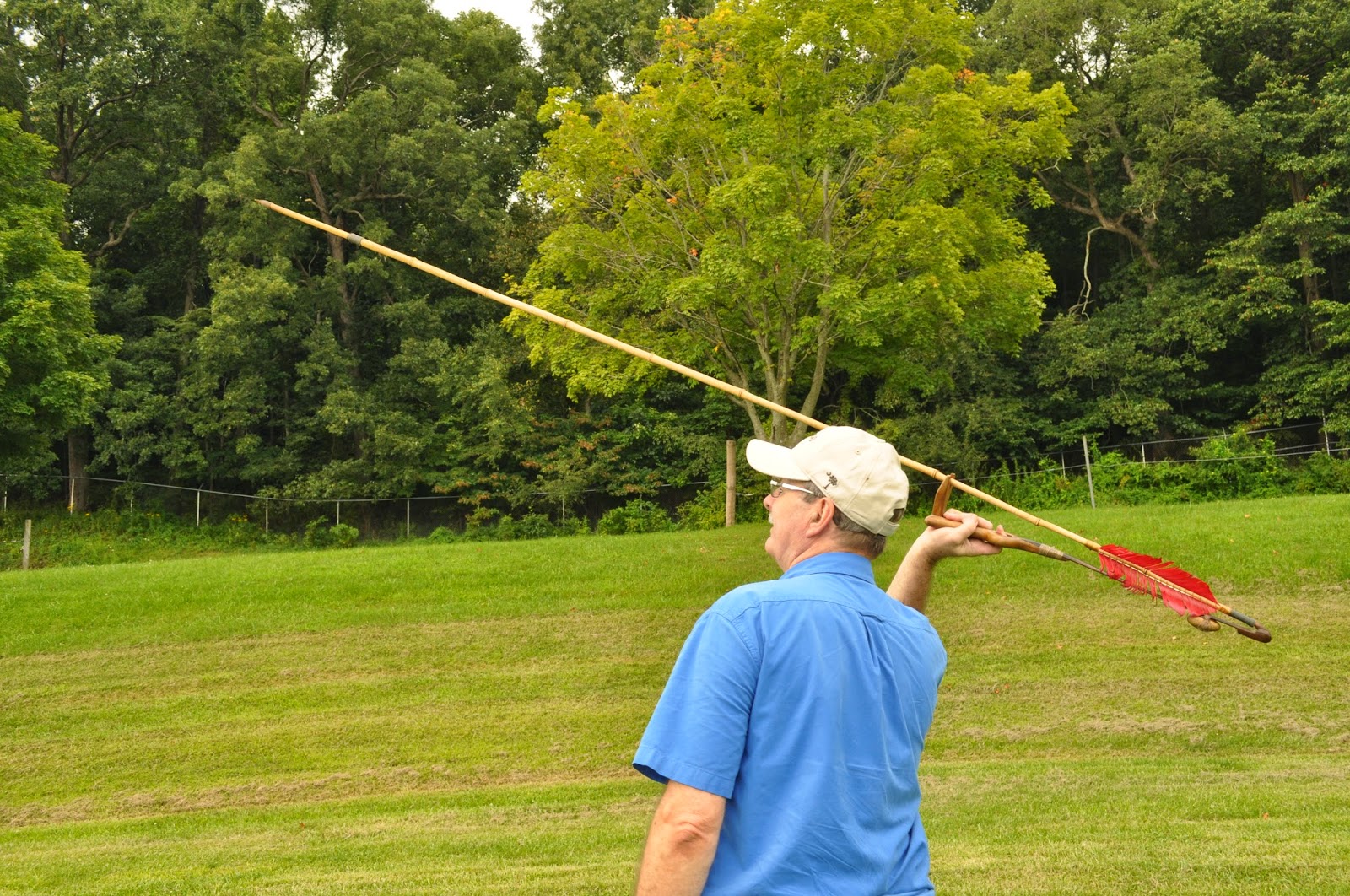
At the annual picnic of the Kokosing Chapter of the Archaeological Society of Ohio (ASO)--held at the Knox County Fairgrounds--Steve House gets ready to launch a spear with an atlatl, a device used for tens of thousands of years worldwide for more killing power with much less effort.  House has a degree in archaeology and is president of the Muskingum Chapter of  ASO.  (Photo by Don Comis)

House sends the spear on its way (visible in sky in far top left of photo).  It impaled itself in the ground, by a tree,  abut 50 yards from House.  (Photo by Don Comis)


What can go 100 miles an hour and reach 600 yards, pre-dating the bow-and-arrow?  The answer, an “atlatl”, doesn’t tell you much, let alone how to pronounce it.

But prehistoric man, dating back to about 30,000 years ago, used this home-made, hand-held device to launch their spears with more power and distance and less wear and tear on the hunters’ bodies.

I first heard about these devices when I joined the Kokosing Chapter of the Archaeological Society (ASO) of Ohio, but I couldn’t grasp what they really looked like or how they worked based on just verbal descriptions and sketches.

So I was thrilled to learn that there would be a demonstration of atlatl spear-throwing at the annual picnic of our archaeological club tonight—and that the Brown Family Environmental Center at Kenyon College would have a demonstration of making atlatls on Thursday, August 28, from 4 to 7 p.m.  Two representatives of Thunderbird Atlatl, the world’s largest atlatl manufacturer, will conduct the demonstration.

Steve House, president of the Muskingum Chapter of the  ASO,  demonstrated the atlatl  outside of our picnic area, shooting spears into a target.  He took me farther away to demonstrate a long distance throw and I watched him launch he spear about 50 yards, impaling itself in the ground near a tree.

House said that a man in southwest Ohio recently won first place in the World Atlatl Association’s International Standard Accuracy Contest with almost a perfect score.  The atlatl is still in use throughout the world.  It can kill big game such as elk, bear, and deer.   Pennsylvania has a limited season for hunting with an atlatl.  Missouri allows hunting with an atlatl only for small game, not deer, while in the south the device is combined with a reel and used to fish.

House showed several types of atlatls and talked about the complex design that launches spears with such force, including a balancing weight.  His spears had small copper tips.  The tips can be small and lightweight because much of the killing power is in the force with which the spear is launched.

He used bamboo for his spears but said primitive man used many different woods and other materials such as marsh grasses.  House’s spears were not much taller than him, but he said that some hunters use long spears, citing South American hunters  with 12-foot-long  spears .

I should get used to taking videos so I could have shown House practicing with his spears until late in the evening.  Besides, I couldn’t take all the still photos I wanted because I didn’t have a full battery, although I own three camera batteries.

I’ll write Part II on August 28, after seeing how atlatls are made, at Kenyon College.  The Ohio Atlatl Association has a Facebook page.  Also, Ray Strischek , who makes and throws atlatls in Athens, Ohio, has a nice website.

The Kokosing Chapter has meetings open to the public on the third Thursday of each month, at 7:30 p.m. at the Knox County Career Center.  For more details, check out the "Archaeological Finds" and "Archaeological Slides" sections of my website.


Sunday, August 10, 2014

An Ohio Prairie Primer Walk for Bird Lovers

Guy Denny showing his prairie to local Audubon birdwatchers on an August 9 tour.  (Photo by Don Comis)

Guy Denny seems to stand as tall as the big bluestem grass in the prairie he created on his farm in Fredericktown.

With his straw cowboy hat, belt buckle and jeans and standing in his prairie, you could easily think he’s out West in the Great Plains rather than in Ohio.  Only the 10-power lens handing around his neck tells you he’s also a man with a scientific bent.

But Denny tells the group on tour from the East Central Ohio Audubon Society that there were cattle drives in Ohio, as well as bison, elk and prairie chickens in central and northwest Ohio in the days when Ohio had one to two thousand square miles of prairie.  He cited examples of those former prairies including the Sandusky Plains 20 miles east of Fredericktown, as well as the Darby Plains and Piqua Plains.

He said all the prairies in the United States form in the rain shadow of the Rocky Mountains, on the east side where there is much less rainfall.  The glaciers were also critical in their formation, creating several thousand years of sustained drought that killed off trees and helped grass spread in its wake  throughout the Midwest and Eastern United States.

These prairies, he said, were lost when drainage ditches drained the lands to grow corn and soybeans.
When Guy Denny moved to his 50-acre farm in Fredericktown 18 years ago, he decided to try planting a small strip of prairie plants along his driveway.   That strip has since grown to at least 20 acres of his property, the rest being woods.    He has coyotes, deer, wild turkeys, fox squirrels, screech owls, and mink on his land.

Denny retired in 1999 from a 33-year career with the Ohio Department of Natural Resources (DNR), serving as chief of the Division of Natural Areas and Preservesmanaging nature preserves on state lands, and became an outdoors writer and advocate for protecting Ohio natural areas and preserves.

During the August 9  tour, Denny said that nature preserves are not city parks and have to be managed differently.  He compared them to the historical documents room of a public library, where the materials have to be more protected than the regular books on loan.

He explained to the bird watchers how he used Roundup to clear existing vegetation which included a lot of goldenrod and Canadian thistle.  He also rototilled, but thinks that was a mistake because it stirs up the underground seedbank, allowing weeds to compete with his prairie plantings.  He says that he know someone at Ohio University who killed existing vegetation without herbicides, by covering the land for a  growing season with plywood or sheets of tin.

This is similar to advice in “Birdscaping in the Midwest”, a book about creating habitats for birds and other wildlife.  The author of that book suggests covering land with layers of newspaper.  I’ve found I couldn’t come up with enough newspaper to do that, so I did a lot of rototilling and then finally covered the land with a permeable landscape fabric.  That’s expensive but I think it can be re-used and it’s easier and no more expensive than rototilling, I think.

You could tell from the questions that at least some in this group are thinking about creating  a prairie section on their land.  Denny said that covering the land with scrap material is better suited to smaller plots, like a quarter acre, while herbicide may be required for larger areas.

Denny also manages his prairie by a controlled burn every year, to prevent trees and shrubs from overtaking the prairie plants.  He has 25 years of experience doing those controlled burns for Ohio’s DNR.  He helps the Brown Family Environmental Center staff with their burns and they in turn help him on his.
Fortunately, I don’t think those burns are needed on smaller plots!

He said that while it’s less expensive to plant seeds, the results take longer.  Most of the growth from the seeds is underground for the first two years.  In fact, Denny said that even for mature prairies, two-thirds of the growth is underground in deep roots, so looking at a prairie is like looking at the tip of an iceberg.

But is that tip ever beautiful with the bright red of royal catchfly flowers, the white flowers of culver’s –root and rattlesnake master flowers, the purple flowers of joe pye weed and prairie coneflower, and the yellow flowers  of other prairie coneflowers,  brown-eyed susans , partridge-pea, and ashy sunflowers.  All of these and so much more set off with plants that grow very tall, including grasses like big bluestem that provide a nice background for the colorful flowers.

He warned that switchgrass, a grass I planted in Maryland and will probably plant at Apple Valley, can spread.   He advises anyone starting a prairie from seed to choose partridge pea seeds first because they will make a showing the first growing season.

He also invited the group to return on September 27 at 10 a.m. for a prairie seed collecting field trip. He said that Gail Martin of “Natives in Harmony” in Marengo (www.nativesinharmony.com) would be there.   I’m coming back then, hoping to get some partridge pea seeds and seeds of other plants for my own little prairie.

But I'm not sure I can wait until September 27 to start my garden. I'll probably order a pre-planned package of 96 plants for a “Monarch Habitat Garden” in a 9- by 18-foot area of my yard from www.prairienursery.com.    This company ships plants on September 15 since September is the time to plant the seeds or plants.   It also sells partridge-pea seeds and says this annual is often interseeded with prairie plant seed mixes.   I may order these seeds soon as well, and try planting them around the 96 perennial plants.

Denny believes he is the steward of the land he lives on, not its owner.  To back this up, he plans to sign a conservation easement with the Owl  Creek Conservancy to protect it from development forever.

For a little more information on Denny’s prairie and controlled burning, check out my July 27 blog on my earlier tour of his prairie, which was part of the 13th annual “Explore the Nature of Knox County” series.  The next event in that series is “Fossils of Knox County”, indoors at the Brown Center on Saturday, September 6, from 1:30 to 3:30 p.m.  For more information, go to the Owl Creek Conservancy’s website.

Also, check out my website.

Denny says partridge-pea is a good first prairie planting with seeds because it produces showy flowers right away, unlike many paririe plants that don't emerge above-ground even until after 2 years.  (Photo by Don Comis)

Tiger swallowtail butterfly on prairie coneflower on Guy Denny's prairie in Fredericktown.  (Photo by Don Comis)


Wednesday, August 6, 2014

From Golf Course to Green Burial Cemetery/Nature Preserve

Kenyon College’s land trust, the Philander Chase Corporation, is turning the defunct Tomahawk Golf Course on Quarry Chapel Road, in Gambier, into a public “Kokosing Nature Preserve” with a small golf course and a “green burial” cemetery.

I love the idea because I’ve long felt that cemeteries are public nature preserves and parks.  That really hit me when I began making cremation plans at a Honolulu public cemetery as my sister, Cheryl, was dying from colon cancer.

Despite the sight of the crematorium, on each of my trips to the cemetery, before and after her death, I was unexpectedly uplifted by the wild birds in the park, including a flock of green parrots.   I bought a “Birds of Hawaii” guidebook that listed the cemetery as a primary birdwatching spot on Oahu—and the best place to see these green parrots.

I’ve also enjoyed birds at the Howard cemetery at Apple Valley.

So I enjoyed the article I read today on the trust’s purchase of the 51-acre Tomahawk Golf Course property, in the Summer 2014 issue of Kenyon’s alumni bulletin, online at "http://www1.kenyon.edu/newsdigest/bulletin/20140805kcab/".  The article states that this is one of only 3 nature conservancy cemeteries in Ohio and 42 exclusive “green burial” cemeteries in the country.  It is also the first nationally at a college or university.

The article explains that, “Green burial resumes practices of old, removing the environmental barriers of conventional burial practices and allowing the dead to ‘return to dust’…Formaldehyde, a carcinogen, is forbidden in green burial, as are concrete burial vaults and lids, which are not biodegradable.  In addition, caskets must be made of plant-based materials.”

And, the article adds that the Kokosing Nature Preserve “will be designed to reflect a naturalistic appearance with native plants…In addition, it will be protected in perpetuity, exclusively for conservation, meaning the land may never be developed.”

Landscape architect and Philander Chase Corporation trustee Stephen Christy, who graduated from Kenyon in 1971, is replacing evergreens with oaks and hickories and planting orchard grass and other pasture grasses, interspersed with black-eyed susans and asters.

A Peaceful Meadow for All

The article states that the cemetery will be ready in 2015 and that “Graves can be designated with flat, natural stone markers, though not the heavily polished headstones used in most cemeteries.  The final result will be a peaceful, natural setting ideal for walks and quiet contemplation, more closely resembling a meadow than most of today’s headstone-rowed cemeteries…Christy is still mapping the plots of the Kokosing Nature Preserve, but the property is expected to have a total of 2,000 to 4,000 spaces, making it a significant revenue source for the land trust in the coming years.”

And the article says that Snyder Funeral Homes in Mount Vernon now offers full green burial services.
According to the article, the Philander Chase Corporation has preserved more than 5,000 acres of land near the College.

As an example of other land preservation efforts by the college, the Brown Family Environmental Center has a 480-acre preserve that helps to keep the waters of the Kokosing River pristine.  And the Owl Creek Conservancy, a sister trust to the Philander Chase Corporation, has preserved nearly 2,422 acres.

Sunday, July 27, 2014

Visiting Guy Denny's Ohio Prairie


I finally made it to Guy Denny’s prairie in Fredericktown and boy was it worth it!  A riot of colors, including red cardinal and royal catchfly flowers;  orange/yellow ox-eye daisies;  yellow sunflowers, senna, prairie dock, and compass plant flowers;  pink marsh mallow flowers; white culver’s-root and rattlesnake master flowers;  red-pink  ironweed flower; pink coneflowers and Queen-of-the-Prairie; and tall blue larkspur flowers.

It seemed like each flower had at least one bee on it, not to mention beetles, butterflies, and other pollinators.

Just driving to the parking for the tour was an adventure and thrill, driving a one-lane path a long way off of Route 95.   There I was welcomed by the group, the prairie, and two cats.

Denny created the prairie on one side of the path we walked 10 years ago and the prairie on the other side about 6 years ago, Ray Heithaus said.  Ray, professor emeritus of environmental science and biology at Kenyon College, led the tour, substituting for Denny.   His wife Pat, a retired Kenyon biology instructor, helped the group with plant identification.  Denny retired from the Ohio Department of Natural Resources.

Ray said that Denny maintains the prairie by annual controlled burning, which involves techniques that lead to a low temperature burn that does not reach underground to plant roots.  Denny does this to keep the trees and shrubs he removed from returning.

Ray set the stage for the tour by explaining the history of prairies in the Midwest and Eastern United States. He said that about 12,000 years ago, glaciers destroyed forests and flattened the land, paving the way for the prairies that awaited the European settlers.


4,000-Year Drought Spreads Prairies to East Coast

Then a 4,000 year dry period kept the forests from re-growing, spreading prairies from the Midwest to the East Coast.  After that Native Americans burned the prairies to prevent them from becoming forests again.

That gave me a better understanding of why the U.S. Department of Agriculture’s Beltsville Agricultural Research Center in Maryland, where I worked, found prairie plants sprouting when they stopped mowing certain areas.   And why there was a similar prairie formation in Baltimore, about 25 miles from Beltsville.

Heithaus said that prairies have a symbiotic relationship to people since they need people to periodically burn and clear the land of tree and shrub growth.   And people needed the cleared areas to hunt.   The settlers continued the burning.   Unfortunately their plows ended the symbiotic relationship and destroyed most of the prairies—along with bison and other wildlife.

Jim McCormac, in his July 23 blog says that Ohio has lost more than 99 percent of its original prairies to farming.   He says that all we are left with are “postage stamp-sized museum remnants.”

Heithaus said there are 138 Ohio Nature preserves that need to be managed-- with fire, removing invasive plants, or pesticides-- to preserve original prairie remnants.

Pat gave the gardeners among us practical tips, such as the fact that Queen of the Prairie is hard to grow from seed.  She said Denny has given gardeners seeds of his prairie plants and that he welcomes learning what works as far as getting the seeds to germinate because he is still searching for what works for various seeds.

Heithaus said that Denny’s prairie is eclectic because he obtained his plants from various parts of Ohio including along the Ohio River in Adams County and the Oak Openings Region of Northwest Ohio.  The Oak Openings have a restored oak savanna, in which scattered oak trees grow in grassland.  The Beltsville Agricultural Research Center also restored an oak savanna.

Ray and Pat have experience with creating and maintaining prairies because they have a prairie at the Brown Family Environmental Center at Kenyon and at their home.

We saw two ponds on the tour, one framed by the large pink flowers of marsh mallow.  We also saw a yellow-throated warbler on a bluebird box.

Dearth of Butterflies

The Heithauses said they both have noticed a lack of butterflies in general this year, possibly caused by the cool spring they think also reduced the number of flowers blooming at Denny’s prairie.

I didn’t notice a decrease in blooming because this was my first visit and it was more than colorful enough for me.  Besides the plants mentioned earlier, I remember seeing big bluestem grass, coreopsis, bee balm, tall larkspur, milkweed, and elderberry bushes.  This was the first milkweed I’d seen in a very long time.

I also saw my first Monarch butterfly in a long time.  And we saw a red admiral butterfly, a silver-spotted skipper (a close relative of butterflies), and probably either a meadow or great spangled fritillary butterfly.

Pat said that gardeners could buy prairie plants and seeds at www.prairienursery.com, from which the Brown Center created their wildflower garden and prairie.

This event is part of the 13th annual “Explore the Nature of Knox County” series.   The Owl Creek Conservancy, whose mission is to conserve natural and agricultural areas in Knox County, sponsors the series in collaboration with the Brown Family Environmental Center at Kenyon College, the Knox County Park District, Mission Oaks Gardens in Zanesville, and the Ramser Arboretum near the Village of Jelloway.

Staff of the Brown Center and the Knox Park District will lead the next event , from 1 to 3 p.m. on August 2, meeting at the canoe access area off Laymon Road, near the Brown Center.  Its theme is “Exploring the Kokosing River”.   The description of the event, at the Conservancy’s website  says:  “Wade the Kokosing to discover the diversity of life in our state scenic river and to learn how to measure the river's health.”

Also, check out my website.

Sunday, July 6, 2014

Families Enjoy Green Spaces

Kenyon College student Matti Freiberg engages Kailee Foreman, a regular visitor to the Brown Family Environmental Center at Kenyon, in Gambier, Ohio.  (Photo by Don Comis)


Clay, 11, hunts for water creatures, along
 with  Lindsay Mills  (yellow blouse),
Olivia Mills (blue blouse),
and Hannah Mills (black shirt). 
(Photo by Don Comis)
Watching children circling mini-ponds and excitedly bringing back their hand nets full of snails, tadpoles, beetles, larvae, and a spider--along with sightings of  a green frog and a turtle--makes you realize the value of natural areas to families.

Proud mothers and a father and a grandmother shared in the childrens' excitement at their finds as they emptied their nets into water in a bin for temporary storage before release.

The excitement and interest level was written in the faces of some of the younger children like 6-year-ol Emma Parsisson and the older children like Walker Mills, 11.   Walker yelled that he had seen a turtle and enjoyed seeing both the turtle and the adult frogs he couldn't net.

But his net and that of the other children ended up filling the bin with a tree frog tadpole, a bullfrog tadpole, snails, a "backswimmer" water bug, a "giant water bug', a diving beetle, dragonfly and damselfy nymphs, and a "fishing spider".  Not to be confused with a water strider, the fishing spider is a semi-aquatic spider that uses water like a spider uses a web--to travel on and to sense vibrations of prey, which can include water striders.


The interaction between Kenyon student Matti Freiberg and Kailee Foreman so captures the value of green spaces like that of the Brown Family Environmental Center at Kenyon in Gambier, Ohio, that I couldn't resist this series of closeups, as Kailee amused and amazed me.  (Photos by Don Comis)


For a slightly different version, check out my website.


Sunday, May 4, 2014

A Trail of Three Wetlands

I had quite a weekend attending the first two of 13 events scheduled for this year's 13th Annual “Explore the Nature of Knox County" program. 

On Saturday, I went to the "Trail of Three Wetlands" at the Brown Family Environmental Center and learned more about the vernal pool I had been monitoring for salamander and other amphibian breeding migrations.  Tour leader Siobhan Fennessy, co-director of the Brown Center and a Kenyon biology professor, showed us the eggs of spotted salamanders laid on rocks underwater, proof there had been a spotted salamander migration that I missed.  She said there is concern that vernal pools are on the decline because of tree cutting and other land management changes, which could be very harmful to amphibians, especially salamanders.

She also said concerned landowners can create vernal pools by excavating in the right locations.

The other two wetlands were a skunk cabbage seep fed by the downhill flow of groundwater and a wet meadow that was restored by fencing out cattle.

Sunday's event was at the Ramser Arboretum, a nature preserve about 10 miles from Apple Valley and open to the public.  I'll write about that later this week, along with a related preserve on Proper Road, even closer to Apple Valley.

For a complete schedule of events and directions, go to the Owl Creek Conservancy's website (http://owlcreekconservancy.org) and click on "Upcoming Events".

Siobhan Fennessy (center, in green jacket) at the "Skunk Cabbage Seep", the first stop on the "Trail of Three Wetlands".  (Photo by Don Comis)

Skunk Cabbage Seep Wetland.  (Photo by Don Comis)

Siobhan Fennessy shows a Mayapple plant after group leaves the first stop.  (Photo by Don Comis)

Second Wetland:  Vernal Pool.  (Photo by Don Comis)

The white dots on the two rocks are eggs laid by spotted salamanders in the vernal pool at the Brown Center.  (Photo by Don Comis)

Last stop:  Wet Meadow Wetland. (Photo by Don Comis)

Kenyon biology professor Siobhan Fennessy explains that the restored wet meadow looked like the green pasture on the other side of the fence, 10 years ago.  (Photo by Don Comis)