Showing posts with label butterfly workshop. Show all posts

Saturday, July 12, 2014

Butterfly Workshop Turns Bioblitz

Caterpillar strategically waits on dogbane plant for dogbane beetle to prey on.  (Photo by Don Comis)

Dogbane beetle blissfully unaware that this might be his last meal of dogbane.  (Photo by Don Comis) 

Even mating of butterflies is exposed when Jim McCormac leads a field trip.  (Photo by Don Comis)

This young northern leopard frog is actually one of the bigger-sized creatures unearthed on a recent field trip.  (Photo by Don Comis) 

The sping peeper is definitely not the smallest creature found on the July 12 wetland field trip.  (Photo by Don Comis) 


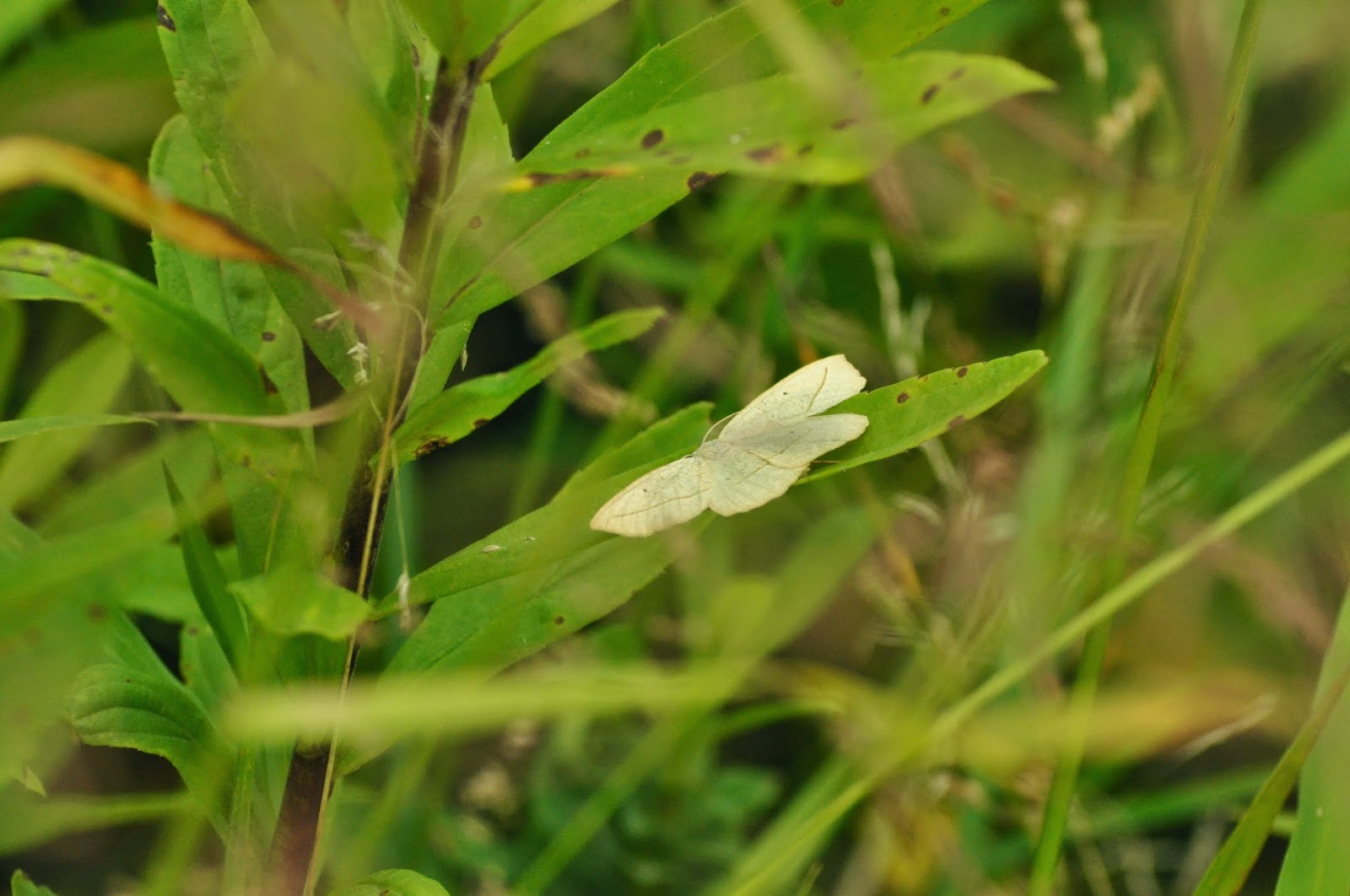
I don't know how this moth gets any sleep, unless it was sleeping when we found it.  I've photographed  this same moth at about 1 in the morning in my yard!  (Photo by Don Comis)

The pondhawk dragonfly looks small and weak when held by Jim McCormac, but it is a big fierce hunter that kills other dragonflies when it's free.  McCormac rescued this pondhawk from a spider and let it go unharmed.  It did bite McCormac, though.  (Photo by Don Comis)

Jim McCormac points out a plant on a field trip he led for the Midwest Native Plant Society's butterfly workshop on July 12.  (Photo by Don Comis) 


A butterfly workshop complete with field trips led by Jim McCormac  and Jeff Belth, author of "Butterflies of Indiana", was an eye-opener for the crowd of about 150 people who came to Caesar Creek Lake in Waynesville, Ohio, to participate.  The workshop was sponsored by the Midwest Native Plant Society.

We never walked far because McCormac or someone else in the group would spot an insect or a plant or a bird. McCormac showed us a baby katydid nestled in a fleabane plant, three dogbane beetles and a fuzzy white Tiger Moth caterpillar on dogbane plants--waiting to eat a dogbane beetle-- a monarch butterfly that was likely laying eggs in milkweed plants, a rare comet darner dragonfly, a white “albino” plant, a young northern leopard frog, a spring peeper, a gall on a plant harboring a gall fly grub, buttonbushes in bloom, a potter wasp, a golden digger wasp….well, you get the idea.

Of course he pointed out many different butterflies, dragonflies and damselflies and at least one day-flying moth and several birds. He enjoyed seeing a yellow-breasted chat bird  [www.en.wikipedia.org/wiki/Chat_(bird] constantly re-appear and pose for us. This was the first time I even knew this bird existed.

Besides the albino plant, he spotted another plant anomaly—foxtail sedge with both male and female plant parts. The normal sedge has separate male and female plants for reproduction.

He also heard things I would have missed, like the singing of tiny crickets, the cry of a red-shouldered hawk, and the call of a willow flycatcher bird.

Later the two wetland groups met and merged so now we had Belth with us too. And boy did that ever give us more of a peek into the hidden world outdoors. His most amazing find was the tiny egg of a butterfly, placed near the edge of a leaf blade, so small I couldn’t see it at all until one of our group loaned me a 10-power magnifying lens! Then I saw it was a beautiful little green gem ball with ribbed lines, like a watermelon several times smaller than a green pea.

Murder and Mayhem Right Under Our Noses

On the trip the leaders pointed out many scenes of violence: an aging blue darner dragon fly eating prey, a pearl crescent butterfly carried off by maybe a robber fly, and an Eastern kingbird waiting to catch dragonflies patrolling the lake for their own prey.

McCormac spotted one assault that put us in the moral dilemma of whether to interfere with Nature—he saw a pondhawk dragonfly caught in a spider web, with the spider approaching to wrap up his snack, dead or alive. We voted with McCormac so he rescued the pondhawk, holding him gently for us to take photos first. It was a fair deal and the pondhawk was now free now to wreak violence on his fellow dragonflies.

One participant told me her main interest in observing moths is to learn what goes on at night in her yard while she sleeps. We all learned more about the mayhem that is part of the wild but wonderful world out there.

Or, to paraphrase what Bleth said in his earlier talk, “I hope more people get outside and realize that there are small things out there that really do run the world.”

For a longer version of this blog, check out my "Daily Nature Blog" on my website.


Tuesday, July 8, 2014

The Exquisite Moths of Mothapalooza


This is one of three photos I've taken that show moths that match or closely match those shown in photos posted by Jim McCormac on his blog, after his recent "Mothapalooza" weekend.  But I haven't seen moths as colorful as he has!  (Photo by Don Comis)
 
On his blogsite, Jim McCormac, a wildlife biologist for the Ohio Department of Natural Resources, has fantastic photographs of moths taken at his annual Mothapalooza weekend, held the last weekend of June this year.

Although I'm on a moth kick too, and learned recently that moths aren't as dull as they seem, I still find some of his moth photos unbelievable, especially the giant leopard moth shown on his July 4th blog.  Originally I though the moth had yellow eyes like jewels, but I read closer tonight and realized the yellow is a form of bleeding the moth does when attacked, to deter predators.  Jim's crew pushed on the moth's thorax to induce the bleeding defense, but no moths were harmed in this production!

I hope to go to his Mothapalooza some year.   I just ordered a mercury vapor bulb to better equip myself for National Moth Week, July 19-27, although my porch lights already give me more moths than I can handle.  I'll try to observe moths for at least an hour each of those nine nights.

That's the easiest part, although it can wreck my day life and chores.  The hard part is submitting all those photos for identification.  Lately I've been sending one photo a night to three websites for identification:  www.butterfliesandmoths.org, www.projectnoah.org, and www.iNaturalist.org.  And those photos were all taken in June or earlier!

I think all three sites are linked to National Moth Week so a submission to any of them gets in the National Moth Week count.

I used to send my photos only to "butterflies and moths", but I haven't got any identified in a while, so I decided to try the other two sites--but I haven't gotten any id's there either.  I think my problem with "butterflies and moths" is just temporary and local, but I suspect that Project Noah and iNaturalist participants rarely get quick identifications, at least not for moths, a creature with far fewer fans than butterflies.  My "butterflies and moths" sightings used to get a response from a regional expert sometimes in less than an hour and rarely in more than three days.

But Project Noah and iNaturalist are still promising sites for other reasons.  iNaturalist has a smartphone app and both sites seem to share my "crazy" idea of documenting every living creature we see wherever we are, including plants.  So I have to love them.

I joined Project Noah when I found out that the Mothapalooza crew would submit its photos of species found to Project Noah.   In fact, tonight I noticed that some of those photos are already posted there and can be found by searching "Mothapalooza Lodge" under "Organisms".  Naturally the participants can't resist sending in photos of all other living things they saw at the Mothapalooza headquartered at a lodge in Burr Oak State Park.

I get a lot of ideas from Jim McCormac's blog and I tend to want to copy his equipment.  Someday I'll get a true macro lens and I hope to get his recommendation on that if I make it to the Midwest Native Plant Society's butterfly workshop on July 12, where McCormac will be. 

I learned from his recent blog that his smartphone is an iPhone 5S and he likes its camera and video features.  I'm overdue for my first smartphone and I think some young people I've talked to were recommending this iPhone model as well ;o)


Other links:

http://insects.about.com/od/entomologytools/ss/How-To-Build-Your-Own-Mercury-Vapor-Light-Setup.htm  (This site taught me I could get by with a 160-watt self-ballasted clear mercury vapor bulb
bought at an online bulb supply store for $25 and a clamp light with a ceramic bulb socket, rated for higher than the bulb wattage.  The guy at that site bought a 300-watt clamp light for $15 at his local big box store, which for me would be Lowe's or Walmart.  He clamps the light to an old camera tripod and secures it with zip ties.  Until I get my camera tripods back from Maryland, I'll probably use a shepherd's hook to clamp to and secure that with zip ties.)

http://www.bioquip.com/  (I decided to order my bulb from this company for convenience, even though it cost me about $50.  I also liked being able to order UV safety glasses from this company with my bulb order, for about $10, just in case looking at the mercury vapor light could hurt my eyes.. We'll see if I get it in time for National Moth Week.)


This is the second moth I've photographed that resembles one on Jim McCormac's recent blogs.  I'm waiting for identification of this one, but am pretty sure it's a grass-vaneer moth and may be the Pasture Grass-veneer, Crambus saltuellus shown on his blog.  I had one of my earlier moth photographs identified as this moth.  As McCormac says, this moth is so little it can easily be overlooked, but it's worth a closer look.  (Photo by Don Comis)


This is the third moth I've photographed that matches one on McCormac's recent blogs.  I had this one identified so I know it's the same moth species,  The Beggar, Eubapha mendica.  (Photo by Don Comis)


(Also check out my website.)