Showing posts with label Owl Creek Conservancy. Show all posts

Sunday, August 10, 2014

An Ohio Prairie Primer Walk for Bird Lovers

Guy Denny showing his prairie to local Audubon birdwatchers on an August 9 tour.  (Photo by Don Comis)

Guy Denny seems to stand as tall as the big bluestem grass in the prairie he created on his farm in Fredericktown.

With his straw cowboy hat, belt buckle and jeans and standing in his prairie, you could easily think he’s out West in the Great Plains rather than in Ohio.  Only the 10-power lens handing around his neck tells you he’s also a man with a scientific bent.

But Denny tells the group on tour from the East Central Ohio Audubon Society that there were cattle drives in Ohio, as well as bison, elk and prairie chickens in central and northwest Ohio in the days when Ohio had one to two thousand square miles of prairie.  He cited examples of those former prairies including the Sandusky Plains 20 miles east of Fredericktown, as well as the Darby Plains and Piqua Plains.

He said all the prairies in the United States form in the rain shadow of the Rocky Mountains, on the east side where there is much less rainfall.  The glaciers were also critical in their formation, creating several thousand years of sustained drought that killed off trees and helped grass spread in its wake  throughout the Midwest and Eastern United States.

These prairies, he said, were lost when drainage ditches drained the lands to grow corn and soybeans.
When Guy Denny moved to his 50-acre farm in Fredericktown 18 years ago, he decided to try planting a small strip of prairie plants along his driveway.   That strip has since grown to at least 20 acres of his property, the rest being woods.    He has coyotes, deer, wild turkeys, fox squirrels, screech owls, and mink on his land.

Denny retired in 1999 from a 33-year career with the Ohio Department of Natural Resources (DNR), serving as chief of the Division of Natural Areas and Preservesmanaging nature preserves on state lands, and became an outdoors writer and advocate for protecting Ohio natural areas and preserves.

During the August 9  tour, Denny said that nature preserves are not city parks and have to be managed differently.  He compared them to the historical documents room of a public library, where the materials have to be more protected than the regular books on loan.

He explained to the bird watchers how he used Roundup to clear existing vegetation which included a lot of goldenrod and Canadian thistle.  He also rototilled, but thinks that was a mistake because it stirs up the underground seedbank, allowing weeds to compete with his prairie plantings.  He says that he know someone at Ohio University who killed existing vegetation without herbicides, by covering the land for a  growing season with plywood or sheets of tin.

This is similar to advice in “Birdscaping in the Midwest”, a book about creating habitats for birds and other wildlife.  The author of that book suggests covering land with layers of newspaper.  I’ve found I couldn’t come up with enough newspaper to do that, so I did a lot of rototilling and then finally covered the land with a permeable landscape fabric.  That’s expensive but I think it can be re-used and it’s easier and no more expensive than rototilling, I think.

You could tell from the questions that at least some in this group are thinking about creating  a prairie section on their land.  Denny said that covering the land with scrap material is better suited to smaller plots, like a quarter acre, while herbicide may be required for larger areas.

Denny also manages his prairie by a controlled burn every year, to prevent trees and shrubs from overtaking the prairie plants.  He has 25 years of experience doing those controlled burns for Ohio’s DNR.  He helps the Brown Family Environmental Center staff with their burns and they in turn help him on his.
Fortunately, I don’t think those burns are needed on smaller plots!

He said that while it’s less expensive to plant seeds, the results take longer.  Most of the growth from the seeds is underground for the first two years.  In fact, Denny said that even for mature prairies, two-thirds of the growth is underground in deep roots, so looking at a prairie is like looking at the tip of an iceberg.

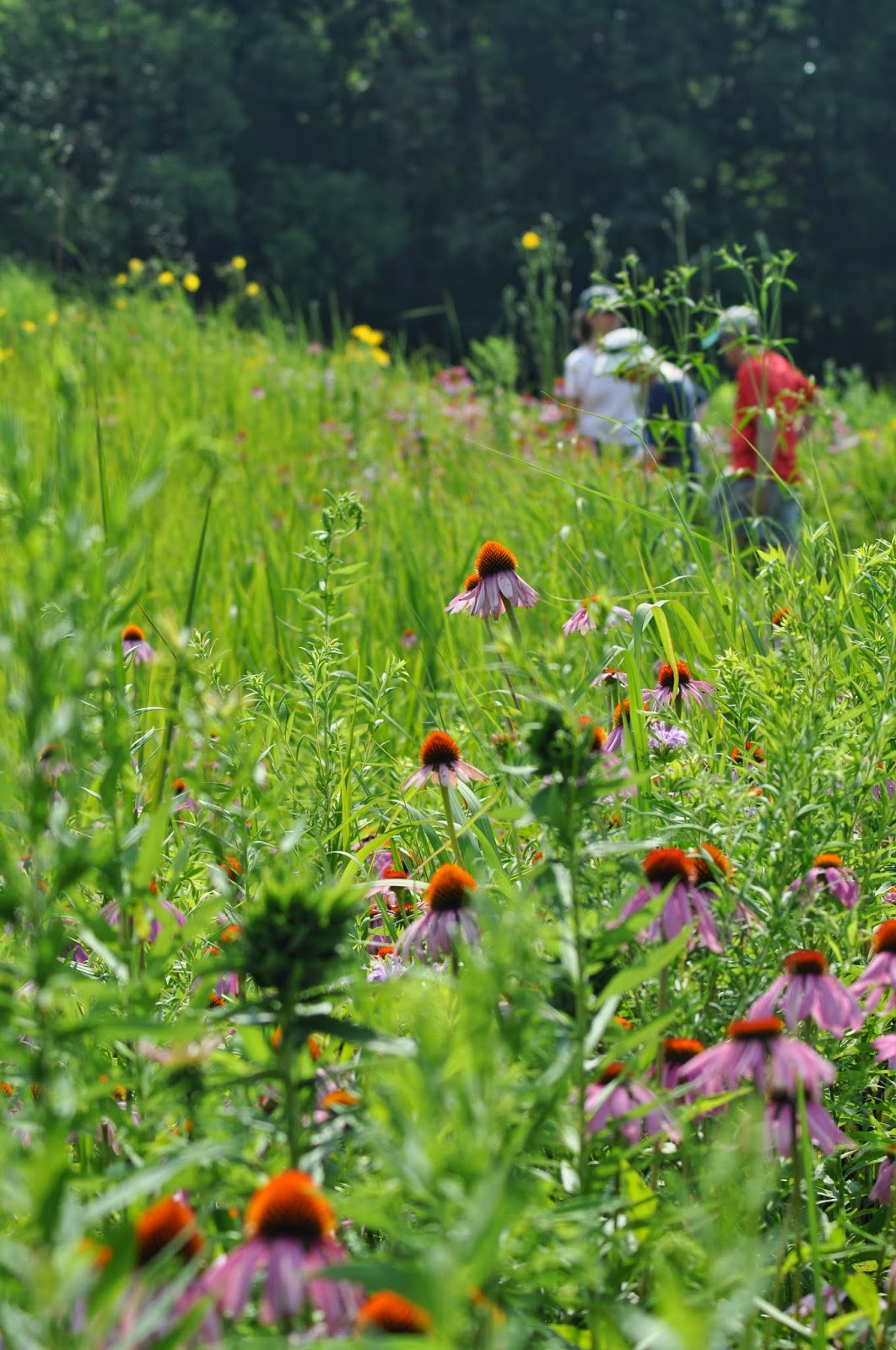
But is that tip ever beautiful with the bright red of royal catchfly flowers, the white flowers of culver’s –root and rattlesnake master flowers, the purple flowers of joe pye weed and prairie coneflower, and the yellow flowers  of other prairie coneflowers,  brown-eyed susans , partridge-pea, and ashy sunflowers.  All of these and so much more set off with plants that grow very tall, including grasses like big bluestem that provide a nice background for the colorful flowers.

He warned that switchgrass, a grass I planted in Maryland and will probably plant at Apple Valley, can spread.   He advises anyone starting a prairie from seed to choose partridge pea seeds first because they will make a showing the first growing season.

He also invited the group to return on September 27 at 10 a.m. for a prairie seed collecting field trip. He said that Gail Martin of “Natives in Harmony” in Marengo (www.nativesinharmony.com) would be there.   I’m coming back then, hoping to get some partridge pea seeds and seeds of other plants for my own little prairie.

But I'm not sure I can wait until September 27 to start my garden. I'll probably order a pre-planned package of 96 plants for a “Monarch Habitat Garden” in a 9- by 18-foot area of my yard from www.prairienursery.com.    This company ships plants on September 15 since September is the time to plant the seeds or plants.   It also sells partridge-pea seeds and says this annual is often interseeded with prairie plant seed mixes.   I may order these seeds soon as well, and try planting them around the 96 perennial plants.

Denny believes he is the steward of the land he lives on, not its owner.  To back this up, he plans to sign a conservation easement with the Owl  Creek Conservancy to protect it from development forever.

For a little more information on Denny’s prairie and controlled burning, check out my July 27 blog on my earlier tour of his prairie, which was part of the 13th annual “Explore the Nature of Knox County” series.  The next event in that series is “Fossils of Knox County”, indoors at the Brown Center on Saturday, September 6, from 1:30 to 3:30 p.m.  For more information, go to the Owl Creek Conservancy’s website.

Also, check out my website.

Denny says partridge-pea is a good first prairie planting with seeds because it produces showy flowers right away, unlike many paririe plants that don't emerge above-ground even until after 2 years.  (Photo by Don Comis)

Tiger swallowtail butterfly on prairie coneflower on Guy Denny's prairie in Fredericktown.  (Photo by Don Comis)


Wednesday, August 6, 2014

From Golf Course to Green Burial Cemetery/Nature Preserve

Kenyon College’s land trust, the Philander Chase Corporation, is turning the defunct Tomahawk Golf Course on Quarry Chapel Road, in Gambier, into a public “Kokosing Nature Preserve” with a small golf course and a “green burial” cemetery.

I love the idea because I’ve long felt that cemeteries are public nature preserves and parks.  That really hit me when I began making cremation plans at a Honolulu public cemetery as my sister, Cheryl, was dying from colon cancer.

Despite the sight of the crematorium, on each of my trips to the cemetery, before and after her death, I was unexpectedly uplifted by the wild birds in the park, including a flock of green parrots.   I bought a “Birds of Hawaii” guidebook that listed the cemetery as a primary birdwatching spot on Oahu—and the best place to see these green parrots.

I’ve also enjoyed birds at the Howard cemetery at Apple Valley.

So I enjoyed the article I read today on the trust’s purchase of the 51-acre Tomahawk Golf Course property, in the Summer 2014 issue of Kenyon’s alumni bulletin, online at "http://www1.kenyon.edu/newsdigest/bulletin/20140805kcab/".  The article states that this is one of only 3 nature conservancy cemeteries in Ohio and 42 exclusive “green burial” cemeteries in the country.  It is also the first nationally at a college or university.

The article explains that, “Green burial resumes practices of old, removing the environmental barriers of conventional burial practices and allowing the dead to ‘return to dust’…Formaldehyde, a carcinogen, is forbidden in green burial, as are concrete burial vaults and lids, which are not biodegradable.  In addition, caskets must be made of plant-based materials.”

And, the article adds that the Kokosing Nature Preserve “will be designed to reflect a naturalistic appearance with native plants…In addition, it will be protected in perpetuity, exclusively for conservation, meaning the land may never be developed.”

Landscape architect and Philander Chase Corporation trustee Stephen Christy, who graduated from Kenyon in 1971, is replacing evergreens with oaks and hickories and planting orchard grass and other pasture grasses, interspersed with black-eyed susans and asters.

A Peaceful Meadow for All

The article states that the cemetery will be ready in 2015 and that “Graves can be designated with flat, natural stone markers, though not the heavily polished headstones used in most cemeteries.  The final result will be a peaceful, natural setting ideal for walks and quiet contemplation, more closely resembling a meadow than most of today’s headstone-rowed cemeteries…Christy is still mapping the plots of the Kokosing Nature Preserve, but the property is expected to have a total of 2,000 to 4,000 spaces, making it a significant revenue source for the land trust in the coming years.”

And the article says that Snyder Funeral Homes in Mount Vernon now offers full green burial services.
According to the article, the Philander Chase Corporation has preserved more than 5,000 acres of land near the College.

As an example of other land preservation efforts by the college, the Brown Family Environmental Center has a 480-acre preserve that helps to keep the waters of the Kokosing River pristine.  And the Owl Creek Conservancy, a sister trust to the Philander Chase Corporation, has preserved nearly 2,422 acres.

Wednesday, July 30, 2014

How to Protect Your Land and Community Forever


Richard Stallard (far right) and Howard Gratz (middle) pass around plants during a tour of wetlands on Dan Galbraith's (in green jacket) land .  Galbraith donated conservation easements on 410 acres in an area that provides drinking water fro more than 40 percent of the people of Knox County, Ohio.  Stallard is vice president for land protection for the Owl Creek Conservancy, which acquired the easements.  Gratz, a former Conservancy trustee, is now a board adviser and volunteer easement monitor.  (Photo by Don Comis) 

Where do you go to if you'd like to protect all or part of your land or land in your neighborhood from development?  A land trust organization.

In the United States, you can find the organizations that are in your county by going to the Land Trust Alliance' wesbsite .  Click on "Find a Land Trust" and you get a map.  Click on your state and then your county and you'll find the land trusts in your county.

For example, in my current county of Knox, Ohio, there are two land trusts:  the Owl Creek Conservancy and the Philander Chase Corporation.   I joined the Owl Creek Conservancy.  Their recent 2014 annual report says that between July 1, 2013 and June 30, 2014, the organization worked with two landowners to complete seven conservation easements totaling 719 acres, more than another square mile of land conserved since their last annual meeting.''

Each of the landowners donated the easements in honor of a deceased loved one.  The report also cites a partnership with Kenyon College's Philander Chase Corporation to include a local 386-acre farm in the state's agricultural easement purchase program.

The report also states that since the Owl Creek Conservancy's founding in 2000, the private nonprofit organization has focused special effort on conserving land northwest of the City of Mount Vernon.  The report says that, "In addition to being prime farmland, that area is the site of the large aquifer recharge, providing drinking water for more than 40% of the population of Knox County...Five of the seven easements completed since we last met cover 410 acres within this area.  They bring our total in this area to 821 acres."

The report explains that "Conservation easements are in essence plans for the future use of land.  Land owners are legally empowered by our system of property rights to lay such plans in accord with their desires."

As an example of how the easements work, farmer Dan Galbraith granted an easement to protect two wetlands on his land from being farmed.   They are a small area of his land that should not be farmed because the wetlands have many environmental benefits including filtering possible pollutants before they reach waterways and aquifers.  Water from Galbraith's land drains into Knox Lake.


The easement carries forwarded perpetually whenever the land changes hands.

The Owl Creek Conservancy's mission is to work with landowners to conserve "farmlands, stream corridors, aquifer-and watershed-protection areas, wildlife habitats, woodlands, scenic vistas, and ecologically sensitive area of environmental, historic, and community importance."

Sometimes people think that such preservation work is against agriculture, but far from it, they work with farmers who want to preserve farmland and not let it be torn apart for business or housing complexes.

Likewise, the Philander Chase Corporation's mission is to "To preserve and maintain the farmland, open spaces, scenic views, and characteristic landscapes surrounding Kenyon College and Gambier, Ohio."

When I moved to Ohio, I felt I had abandoned my life goal of preserving 25,000-plus acres of federal and other public land where I worked in Maryland .   But, in fact, the people at the Owl Creek Conservancy helped me learn the first step in the process, contacting the land trust organizations in the counties the land sits on.

Now that I'm back in Ohio, I've become similarly protective of the green space where the Mt. Vernon Developmental Center sits, where I once also worked.  I'd hate to see that place close and have its 310 acres of varied natural habitats paved over for more stores or homes.  One of many benefits of preserving green space is also reducing vehicle traffic and Vernonview Road, which passes the Center, is already clogged.

Donating easements or land to the Owl Creek Conservancy or similar land trust not only benefits the community and the environment, but also may bring significant tax breaks to landowners.


Sunday, July 27, 2014

Visiting Guy Denny's Ohio Prairie


I finally made it to Guy Denny’s prairie in Fredericktown and boy was it worth it!  A riot of colors, including red cardinal and royal catchfly flowers;  orange/yellow ox-eye daisies;  yellow sunflowers, senna, prairie dock, and compass plant flowers;  pink marsh mallow flowers; white culver’s-root and rattlesnake master flowers;  red-pink  ironweed flower; pink coneflowers and Queen-of-the-Prairie; and tall blue larkspur flowers.

It seemed like each flower had at least one bee on it, not to mention beetles, butterflies, and other pollinators.

Just driving to the parking for the tour was an adventure and thrill, driving a one-lane path a long way off of Route 95.   There I was welcomed by the group, the prairie, and two cats.

Denny created the prairie on one side of the path we walked 10 years ago and the prairie on the other side about 6 years ago, Ray Heithaus said.  Ray, professor emeritus of environmental science and biology at Kenyon College, led the tour, substituting for Denny.   His wife Pat, a retired Kenyon biology instructor, helped the group with plant identification.  Denny retired from the Ohio Department of Natural Resources.

Ray said that Denny maintains the prairie by annual controlled burning, which involves techniques that lead to a low temperature burn that does not reach underground to plant roots.  Denny does this to keep the trees and shrubs he removed from returning.

Ray set the stage for the tour by explaining the history of prairies in the Midwest and Eastern United States. He said that about 12,000 years ago, glaciers destroyed forests and flattened the land, paving the way for the prairies that awaited the European settlers.


4,000-Year Drought Spreads Prairies to East Coast

Then a 4,000 year dry period kept the forests from re-growing, spreading prairies from the Midwest to the East Coast.  After that Native Americans burned the prairies to prevent them from becoming forests again.

That gave me a better understanding of why the U.S. Department of Agriculture’s Beltsville Agricultural Research Center in Maryland, where I worked, found prairie plants sprouting when they stopped mowing certain areas.   And why there was a similar prairie formation in Baltimore, about 25 miles from Beltsville.

Heithaus said that prairies have a symbiotic relationship to people since they need people to periodically burn and clear the land of tree and shrub growth.   And people needed the cleared areas to hunt.   The settlers continued the burning.   Unfortunately their plows ended the symbiotic relationship and destroyed most of the prairies—along with bison and other wildlife.

Jim McCormac, in his July 23 blog says that Ohio has lost more than 99 percent of its original prairies to farming.   He says that all we are left with are “postage stamp-sized museum remnants.”

Heithaus said there are 138 Ohio Nature preserves that need to be managed-- with fire, removing invasive plants, or pesticides-- to preserve original prairie remnants.

Pat gave the gardeners among us practical tips, such as the fact that Queen of the Prairie is hard to grow from seed.  She said Denny has given gardeners seeds of his prairie plants and that he welcomes learning what works as far as getting the seeds to germinate because he is still searching for what works for various seeds.

Heithaus said that Denny’s prairie is eclectic because he obtained his plants from various parts of Ohio including along the Ohio River in Adams County and the Oak Openings Region of Northwest Ohio.  The Oak Openings have a restored oak savanna, in which scattered oak trees grow in grassland.  The Beltsville Agricultural Research Center also restored an oak savanna.

Ray and Pat have experience with creating and maintaining prairies because they have a prairie at the Brown Family Environmental Center at Kenyon and at their home.

We saw two ponds on the tour, one framed by the large pink flowers of marsh mallow.  We also saw a yellow-throated warbler on a bluebird box.

Dearth of Butterflies

The Heithauses said they both have noticed a lack of butterflies in general this year, possibly caused by the cool spring they think also reduced the number of flowers blooming at Denny’s prairie.

I didn’t notice a decrease in blooming because this was my first visit and it was more than colorful enough for me.  Besides the plants mentioned earlier, I remember seeing big bluestem grass, coreopsis, bee balm, tall larkspur, milkweed, and elderberry bushes.  This was the first milkweed I’d seen in a very long time.

I also saw my first Monarch butterfly in a long time.  And we saw a red admiral butterfly, a silver-spotted skipper (a close relative of butterflies), and probably either a meadow or great spangled fritillary butterfly.

Pat said that gardeners could buy prairie plants and seeds at www.prairienursery.com, from which the Brown Center created their wildflower garden and prairie.

This event is part of the 13th annual “Explore the Nature of Knox County” series.   The Owl Creek Conservancy, whose mission is to conserve natural and agricultural areas in Knox County, sponsors the series in collaboration with the Brown Family Environmental Center at Kenyon College, the Knox County Park District, Mission Oaks Gardens in Zanesville, and the Ramser Arboretum near the Village of Jelloway.

Staff of the Brown Center and the Knox Park District will lead the next event , from 1 to 3 p.m. on August 2, meeting at the canoe access area off Laymon Road, near the Brown Center.  Its theme is “Exploring the Kokosing River”.   The description of the event, at the Conservancy’s website  says:  “Wade the Kokosing to discover the diversity of life in our state scenic river and to learn how to measure the river's health.”

Also, check out my website.

Monday, July 7, 2014

Mission Oaks Gardens: Green Space for All


Mighty Gardens from Little Yards Grow


After visiting the Chelsea Flower Show in London in 1990, Susan Hendley made the “mistake” of telling her husband Bert that they should have a garden of their own at the home in Zanesville they had recently bought and renovated.


As Susan says, “This is his idea of a garden,” referring to present day Mission Oaks Gardens--more than 5 acres filled with hundreds of trees—including 200 kinds of conifers and 25 kinds of magnolia—1,200 varieties of perennials, two ponds, a spectacular rocky waterfall, a bog garden, and numerous azaleas and rhododendrons, just to mention some of the attractions.


The Hendleys formed the non-profit Mission Oaks Gardens Foundation to operate the Gardens as a community education garden getting more children and their parents outdoors. In 2010, they donated the Gardens to the Muskingum Valley Park District, with the Foundation doing the day-to-day operations. The gardens are now protected forever as green space and open to the public from dawn to dusk seven days a week.


They named the Gardens for the Mission Revival style of their 1920s era home and the mature white oaks in a ravine behind their house.


The name also reminds that the gardens have a mission. As Bert says, it is to preserve green space and introduce the public to plants they may not be familiar with, those not typically available at garden centers and those not thought to grow well in central Ohio. Susan adds that the mission is also to show the importance of parks to families, giving children a chance for outdoor recreation.


One of the secrets to Bert’s success it that he joins garden societies dedicated to each plant he wants to learn more about, including ivy, hosta, conifer, rhododendron, azalea, and holly.


There are three sections to the Gardens: a 1 ½ acre conifer garden with 300 trees—many not native to North America—and a large pond and a spectacular rock waterfall; a 1/4 -acre perennial garden with the classic color chart arrangement, from red to blue; and a 2-acre woodland garden.


The Gardens have so many plants and varieties, I can hardly do them justice as a beginning gardener—starting with the rhododendrons and azaleas near the entrance and on to serviceberry, magnolia, holly, maple, persimmon, dogwood, buckeye, and evergreen trees, to hellebores and primrose. They include unusual weeping versions of familiar trees, like redbud and cypress. Bert plans to add more native plants in the future.


Along with almost every plant you get a story relating to things like the variety’s origins and even Bert’s recipe for an organic fertilizer for rhododendron along with the advice to plant container-grown rhododendron a bit above ground and then cover with pine bark mulch.


But his main advice, offered repeatedly and pointedly on a tour I took on May 25, was that you’ll never know what will work in your garden unless you try it. He’s found success with many plants that were said not to be hardy enough to survive in Ohio.


The Gardens grew over time as properties came up for sale. He bought one such property, which included a dump. To clear it, Bert had to cart away over 50 dump loads of everything from refrigerators to invasive plants. But he found that the clay shards from a former manufacturer of decorative tiles provided the perfect drainage for part of the conifer garden, which includes conifers from a wide range of areas, including China, Japan, and Korea. He found that many of these conifers don't mind Ohio's cold winters, as long as they can keep their "feet" dry.


The sight of what he did with that property caused an adjacent neighbor to offer the use of some of her land for the gardens. Then an estate sale gave the Park District the chance to buy another property. And, a neighbor leaving town sold his property to the Park District. That land had auto parts buried by a mechanic in the 1930s, near a large sewer ditch. The Mayor of Zanesville at the time made a deal with Bert--if he paid for the pipes the town would install them since it would help keep Zanesville's waterways clean. It took Bert six months to clean the area of car parts and invasive plants, with care taken not to disturb the natural terrain.


Bert admires what Karen Buchwald of the Ariel Corporation does for Mt. Vernon, such as expanding Foundation Park and believes that this gives Mt. Vernon an edge over many other small towns without such great parks--an edge he hopes Zanesville also has with the Mission Oaks Gardens.


The tour of the Mission Oaks Gardens was the fifth event in the “13th Annual Explore the Nature of Knox County” series. I went to the sixth event, the Brown Family Environmental Center’s “Frogs and Tadpoles Family Adventure Day”, at Kenyon College, in Gambier, Ohio, on July 5. Anyone doubting the value of parks to families should take a look at some of the photos I took that day.


The Brown Center collaborates in the series, along with the Knox County Park District, Mission Oaks Gardens, and the Ramser Arboretum. The next event will be at 10 a.m. on July 26, at the Guy Denny wildflower prairie in Fredericktown.


Denny is an advisor to the Owl Creek Conservancy, which sponsors the series, and shares the Mission Oaks Gardens goal of preserving green space.


For more information on the Mission Oaks Gardens go to http://missionoaksgardens.org. For information on the “Explore the Nature of Knox County” series and the Owl Creek Conservancy, go to: www.owlcreekconservancy.org.

Also check out my website:  www.doncomis.simplesite.com.


Bert Hendley shows our tour group one of the many scenic spots at the Mission Oaks Gardens, a treasure he has donated to the public, forever.  (Photo by Don Comis)

Bert Hendley points out some trees to a group touring as part of the "13th Annual Explore the Nature of Knox County" series.  (Photo by Don Comis)

Bert Hendley points out the residential neighborhood the Mission Oaks Gardens sits in the midst of, something rare for showy gardens.  (Photo by Don Comis)

You can get an idea of Bert's friendly, thoughtful manner, as he leads of tour of Mission Oaks Gardens, in Zanesville, Ohio.  (Photo by Don Comis)


Bert Hendley talks to his dog (hidden in shade in far right), as well as to  plants.  (Photo by Don Comis)


Richard Stallard, Owl Creek Conservancy trustee and retired Kenyon College professor, (wearing black hat, far left) listens, along with others on tour, to Bert Hendley near the Hendleys home at the entrance to Mission Oaks Gardens.  (Photo by Don Comis)

Before the tour begins, Stallard talks with landowner who came to learn more about the rights and responsibilities involved in granting easements to conservancy organizations such as the Owl Creek Conservancy.  (Photo by Don Comis)


Tuesday, May 20, 2014

On the Trail of Two Wetlands: Event #4

On May 10, I toured the Galbraith Farm with farmer Dan Galbraith and four others, a year after he donated an agricultural conservation easement for the 210-acre farm to the Owl Creek Conservancy to keep the land in farming forever.

Howard Gratz, and Owl Creek Conservancy trustee and avid birdwatcher, led the tour, accompanied by Richard Stallard, a geneticist and Conservancy trustee.  Galbraith enjoyed the tour as much as the rest of us, seeing the diverse plants and abundant wildlife, including birds and toads.

The tour focused on two wetlands on the farm.  Stallard said that the main reason the farm was chosen for the easement was the need for these wetlands to filter out soil and possible attached pollutants before reaching nearby Knox Lake.  Two creeks run through these wetlands and drain into the lake.  Gratz added that Ohio had already lost 90 percent of its wetlands, having drained them for farming and other development.  Besides filtering out pollutants, wetlands reduce flooding potential and provide habitat for wildlife and plant diversity.

Gratz identified many plants for us as well as many birds by sound, including three types of warblers and a rose-breasted grosbeak, which he said are particularly plentiful this year.   Many of the plants were indicators of wetlands, such as marsh marigold and skunk cabbage.  We also saw jewelweed, nettles, common milkweed, horsetails, willow, elderberries, angelica, spring beauty, yellow violets, white violets, wild blue phlox, ferns, ramps, Dutchman’s breeches, wild geranium, false Solomon’s seal, and meadow rue.

A wooded area connecting the two wetlands had an airy feeling and consisted of numerous trees, including black cherry, sycamore, ash, and oak.

The tour of the Galbraith Farm was the fourth event in the “13th Annual Explore Knox Nature” series, which began with the Earth Day festival at Kenyon College on April 6.   There will be one or two events every month through December.  The next event will be at 2 p.m. on May 25, at the Mission Oak Gardens in Zanesville, where I’m told we’ll meet another amazing man, who did his own urban renewal project by turning his neighborhood from littered lots to wondrous public gardens.

For more information on the “Explore Knox Nature” series and the Conservancy, go to:  www.owlcreekconservancy.org.

One of three American toads that delighted us on tour.  (Photo by Don Comis)

This toad charmed us.  (Photo by Don Comis)

We were treated to a great display of marsh marigolds in a wetland on the Galbraith Farm.  (Photo by Don Comis)


Saturday, May 17, 2014

On the Hardwoods Trail--Ramser Arboretum, Event 3

Here's the article I promised on my trip to the Ramser Arboretum--it's late due to computer problems.  It was quite a thrill to find out that I, as a member of the general public, have more land to explore nearby--680 acres to be exact. 

It's all because one man, Russell Ramser, planted 150,000 native Ohio hardwood trees on 265 of those acres, creating what has since his death become a public preserve that provides a wonderful habitat for birds and other wildlife.  It is listed as a birding hotspot on e-bird (www.ebird.org). 

I got my first clear view of a warbler--a black-throated green warbler--on that May 4 tour, leading me to later identify a yellow warbler at bird baths in my yard!  I also had numerous plants identified for me for the first time, including many early spring plants like white trillium and yellow and longspur violets.

I saw my first Tiger Swallowtail butterfly of the season there and Arboretum director Chris Bowman pointed out  a rose-breasted grosbeak and female scarlet tanager.  And we saw the nest of a blue-gray gnatcatcher.

The Arboretum is next to the Village of Jelloway, about 10 miles from I live.

The Arboretum visit was the third event in the "Explore the Nature of Knox County" series.   The series has an event or two every month, through December.  It began with the Earth Day festival at Kenyon College.

The fourth event was a tour of the "Galbraith Wetlands" near Fredericktown.  Dan Galbraith granted the Owl Creek Conservancy a conservation easement on his two wetlands in perpetuity.  This prevents farming on the wetlands, allowing the wetlands to perform their ecological function of filtering out sediment and other pollutants, while reducing flooding and providing wildlife habitat. 

The next event will be on May 25, at the Mission Oak Gardens in Zanesville, at 2 p.m.  It is the only event that is outside Knox County.

At the Galbraith Wetlands I learned that "Mission Oak is as fascinating as this property [Galbraith's Farm], in its own way."   Burt, the man who created Mission Oak Gardens, volunteered to plant gardens for his neighbors and cleared hundreds of loads of trash from vacant lots which he later bought.   In the process of a one-man volunteer urban renewal, the landowner created an expanse of beautiful gardens for the public.

So, one thing I've gained from the series so far is how much individuals like Russell, Dan, and Burt can do for the environment and the world by following their passions.


Sunday, May 4, 2014

A Trail of Three Wetlands

I had quite a weekend attending the first two of 13 events scheduled for this year's 13th Annual “Explore the Nature of Knox County" program. 

On Saturday, I went to the "Trail of Three Wetlands" at the Brown Family Environmental Center and learned more about the vernal pool I had been monitoring for salamander and other amphibian breeding migrations.  Tour leader Siobhan Fennessy, co-director of the Brown Center and a Kenyon biology professor, showed us the eggs of spotted salamanders laid on rocks underwater, proof there had been a spotted salamander migration that I missed.  She said there is concern that vernal pools are on the decline because of tree cutting and other land management changes, which could be very harmful to amphibians, especially salamanders.

She also said concerned landowners can create vernal pools by excavating in the right locations.

The other two wetlands were a skunk cabbage seep fed by the downhill flow of groundwater and a wet meadow that was restored by fencing out cattle.

Sunday's event was at the Ramser Arboretum, a nature preserve about 10 miles from Apple Valley and open to the public.  I'll write about that later this week, along with a related preserve on Proper Road, even closer to Apple Valley.

For a complete schedule of events and directions, go to the Owl Creek Conservancy's website (http://owlcreekconservancy.org) and click on "Upcoming Events".

Siobhan Fennessy (center, in green jacket) at the "Skunk Cabbage Seep", the first stop on the "Trail of Three Wetlands".  (Photo by Don Comis)

Skunk Cabbage Seep Wetland.  (Photo by Don Comis)

Siobhan Fennessy shows a Mayapple plant after group leaves the first stop.  (Photo by Don Comis)

Second Wetland:  Vernal Pool.  (Photo by Don Comis)

The white dots on the two rocks are eggs laid by spotted salamanders in the vernal pool at the Brown Center.  (Photo by Don Comis)

Last stop:  Wet Meadow Wetland. (Photo by Don Comis)

Kenyon biology professor Siobhan Fennessy explains that the restored wet meadow looked like the green pasture on the other side of the fence, 10 years ago.  (Photo by Don Comis)